P-38 Lightning Why Not Merlin Engines
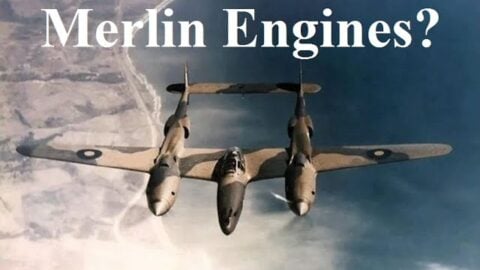
YouTube / Greg's Airplanes and Automobiles
The Lockheed P-38 Lightning was one of the most distinctive fighters of World War II, excelling in long-range escort, interception, and ground attack.
Yet it has long puzzled enthusiasts why it never received the same transformative engine upgrade that elevated the North American P-51 Mustang into legend. When the Rolls-Royce Merlin proved so successful in the Mustang, why did the P-38 not follow the same path?
Designed Around the Allison
From the outset, the P-38 was built around the Allison V-1710. Unlike the Mustang, the P-38 used two Allison engines, each paired with a turbocharger. This combination gave it strong high-altitude performance without requiring the Merlin’s two-stage supercharger system.
The P-38’s performance problems in Europe were not simply about engine power. Early issues came from intercooler efficiency, fuel mixture control, and cockpit conditions at high altitude. These were engineering challenges tied to integration rather than a weak engine. Swapping in Merlin’s would have required a major redesign of the twin boom layout, cooling system, and turbo installation. It was far more complex than the Mustang conversion.
Why Merlin Worked for the P-51
The Mustang’s original Allison engine struggled at high altitude because it lacked an effective supercharger. When fitted with the Merlin, the aircraft gained dramatically improved high altitude performance, turning it into one of the best escort fighters of the war.
The P-38 already solved this problem with turbo superchargers. It could maintain power at altitude without needing a Merlin. In practical terms, the Merlin solved a limitation the Mustang had, not one that defined the P-38 in the same way.
The United States Air Force also had to manage engine supply. Merlin production was prioritized for aircraft that needed it most, especially the P-51. Diverting Merlins to the P-38 would have complicated logistics without guaranteeing a major improvement.
Paddle Props and Manifold Pressure Limits
Critics often point out that the P-38 seemed slow to adopt paddle blade propellers and higher manifold pressures compared to aircraft like the Republic P-47 Thunderbolt and the P-51.
In reality, later versions such as the P-38J and P-38L did receive improved propellers and refinements. However, raising manifold pressure beyond about 60 inches was limited by engine durability and cooling capacity. The compact twin-engine arrangement made heat management more difficult, especially during long missions.
Running two engines at a bigger boost also increased wear and maintenance demands. Any gain in performance had to be balanced against reliability, which was critical for long-range escort missions over the Pacific and Europe.
The Twin Engine Tradeoff
The P-38’s twin-engine configuration brought clear advantages. It offered long-range, heavy-concentrated armament and the safety of engine redundancy. At the same time, it introduced greater weight, complexity, and maintenance demands than single-engine fighters.
These factors made major upgrades harder to implement. Installing Merlins or pushing significantly higher boost levels would have required big structural and systems changes rather than simple modifications. By the time such changes could have been pursued, aircraft like the P-51 and P-47 were already fulfilling those roles efficiently with less complexity.
In service, the P-38 continued to evolve within its original design framework. Improvements focused on reliability, cooling, and handling rather than a complete engine change, allowing it to remain effective across multiple theaters of the war.