Against Orders, He Landed Behind Enemy Lines to Rescue His Commander in a P-51
via Forgetting Is History / YouTube
The Pilot Who Broke Formation to Save His Commander in Occupied France
Air combat over Europe in 1944 followed strict rules. Formation flying, radio discipline, and clear orders were essential to survival. Pilots were trained to trust procedure, even when it meant leaving a fallen comrade behind. On August 18, 1944, during a mission over occupied France, one American pilot chose a different path. His decision placed him at odds with standing orders and exposed him to extreme danger, yet it also saved a life.
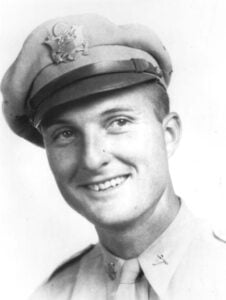
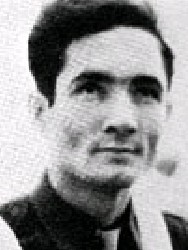
That morning, fighter escorts protected bomber formations heading into German-controlled territory. Among them was Lieutenant Royce Priest, flying a P-51 Mustang. These aircraft were fast, long-range fighters designed to defend bombers from interception. Priest’s unit operated under constant threat from anti-aircraft fire and enemy aircraft, and each mission required discipline and coordination to succeed.
A Mission Disrupted by Fire
As the formation moved inland, anti-aircraft fire erupted from the ground. Black bursts of flak filled the sky, forcing pilots to maneuver quickly. In the confusion, one aircraft was struck. Major Bert Marshall, a respected officer and experienced pilot, reported that his Mustang had been hit. Flames trailed from his aircraft as he struggled to maintain control.
Within moments, Marshall was forced to abandon his plane. His parachute opened as he descended toward farmland below. For most pilots, this marked the end of the mission and the beginning of captivity. Downed airmen behind enemy lines were often captured within hours. Standard procedure required all other aircraft to remain in formation and return to base.
Priest heard the command to hold position and withdraw. He also saw where Marshall had landed. The two men knew each other well, and Priest understood what likely awaited his commander on the ground. German patrols were active across occupied France, and isolated pilots rarely avoided capture for long.
A Decision Against Orders
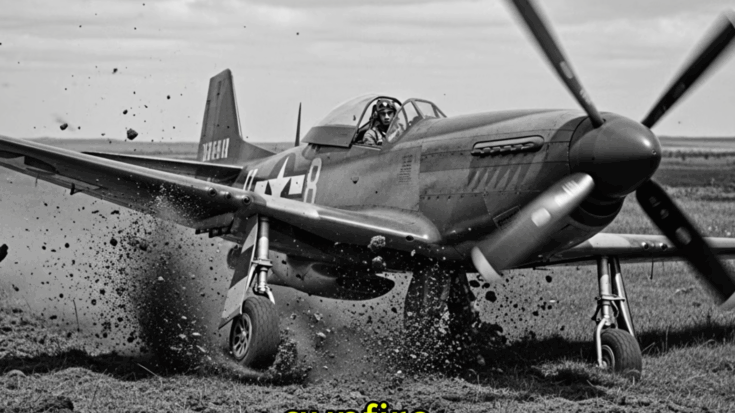
Instead of turning back, Priest broke formation. His aircraft peeled away and dropped toward the countryside below. Such a move was not only dangerous but also a direct violation of orders. A lone fighter at low altitude was vulnerable to ground fire, and landing in enemy territory carried serious risks.
As he descended, Priest searched for Marshall. The landscape offered few suitable landing areas. Fields were uneven, bordered by hedgerows and narrow paths. The P-51 was not designed for rough landings, especially in unfamiliar terrain. Nevertheless, Priest identified a stretch of open ground and prepared to land.
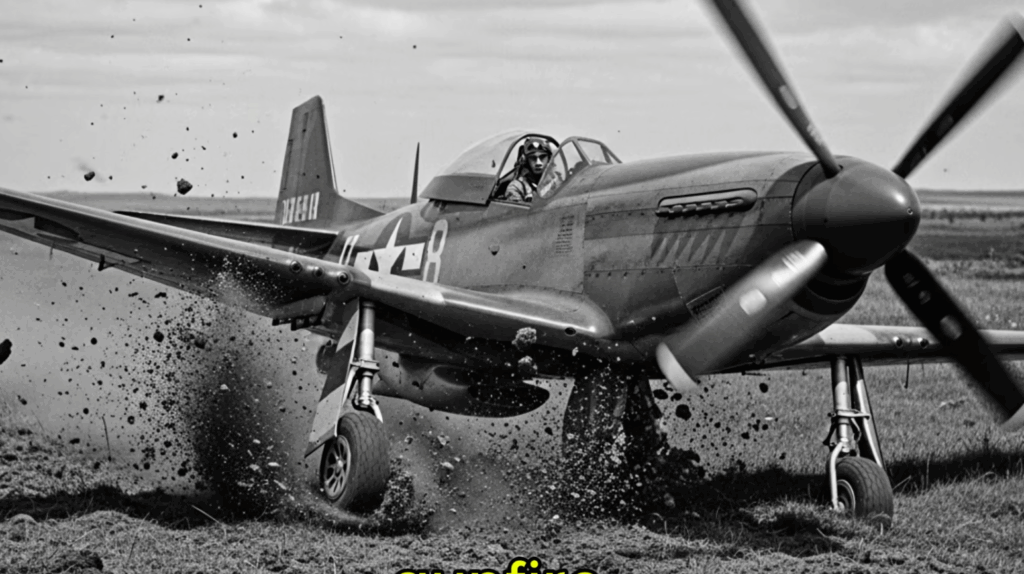
The touchdown was hard. The aircraft bounced and skidded before coming to a stop. Priest quickly opened the canopy and signaled to Marshall, who was already moving toward him. In the distance, signs of approaching vehicles suggested that time was limited.
An Improvised Escape
The P-51 Mustang was built for a single pilot. There was no extra seat, no safety harness, and no room for a second passenger. Despite this, Marshall climbed into the cockpit, positioning himself as best he could behind Priest. The arrangement was unstable, but remaining on the ground was not an option.
Priest advanced the throttle and began the takeoff roll. The uneven field made acceleration difficult, and the added weight reduced performance. As the aircraft gained speed, it struck bumps that threatened to halt the attempt. Near the edge of the field, a hedgerow loomed ahead. At the last moment, the aircraft lifted just enough to clear the obstacle.
Once airborne, the situation remained dangerous. Without proper seating or restraint, Marshall had to hold on while Priest guided the aircraft at low altitude. They avoided predictable flight paths to reduce the risk of ground fire. Gradually, they moved toward Allied-controlled territory.
Return to Friendly Lines
As they crossed into safer airspace, Priest climbed to a more secure altitude. Fuel was limited, and the aircraft had already endured significant strain. Communication with base raised confusion, as reports indicated an unusual situation onboard.
The landing in England was controlled but firm. Ground crews approached quickly and were surprised to find two men emerging from a single-seat fighter. Reports of the incident moved through the chain of command, raising questions about discipline and judgment.
Senior officers reviewed the circumstances. While Priest had ignored direct orders, his actions had preserved the life of another pilot. In the end, the event stood as an example of how individual decisions could alter outcomes, even within the rigid structure of wartime operations.