Why did US pilots love the Thunderbolt so much?
YouTube / Imperial War Museums
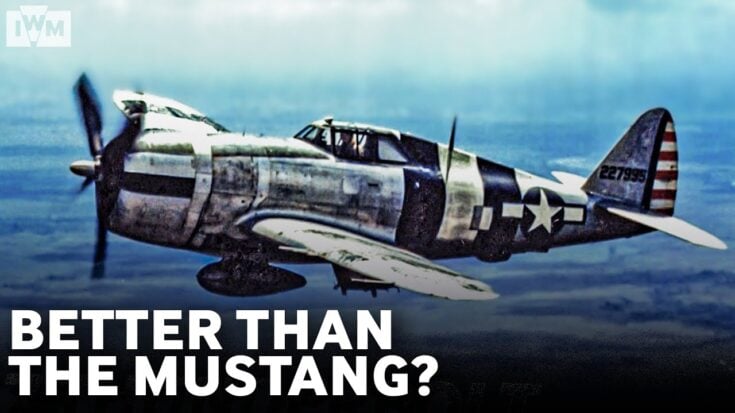
When American forces arrived in East Anglia in 1942, they brought with them an aircraft that looked unlike anything the Luftwaffe had faced. The Republic P-47 Thunderbolt was massive, heavy, and thirsty. It climbed slowly and accelerated with the urgency of a loaded freight train. German pilots who lured one into a vertical climb considered it an easy kill. They were wrong about almost everything else.
Built Around an Engine
The Thunderbolt was designed by Alexander Kartveli and built by Republic Aviation, entering service in 1942 and flying its first European combat missions in April 1943. Its defining feature was the Pratt and Whitney R-2800 air-cooled radial engine producing 2,000 horsepower, wrapped in a fuselage substantial enough to dwarf a Spitfire parked beside it. A 12.5-foot propeller completed the profile.

The aircraft’s nickname, the Jug, came from either Juggernaut or its milk jug silhouette depending on the source, and both explanations suit it equally well.
The air-cooled radial gave the Thunderbolt a survivability advantage that liquid-cooled fighters could never fully match. A single round through the glycol system of a Rolls-Royce Merlin could end a mission and a pilot’s life. Thunderbolts returned to base with cylinder heads missing, battle damage that would have killed other aircraft, and still made serviceable landings. Stories of that kind accumulated quickly enough to become part of the aircraft’s identity.
Firepower and Ground Attack
Eight .50 caliber machine guns, four in each wing, gave the Thunderbolt more concentrated firepower than any Allied fighter of the era. Pilots who fired all eight simultaneously reported the aircraft slowing by 35 mph from the recoil alone. Combined with a bomb-carrying capacity approaching 2,500 pounds, the Thunderbolt became one of the war’s most effective fighter-bombers. During D-Day and the subsequent campaign across France, P-47s flying close air support pulled Allied troops out of difficult positions with strikes delivered directly ahead of ground forces.

Drop tanks extended its range enough to escort B-17s and B-24s departing from East Anglia, roughly doubling operational reach from what early escort missions had managed. A paddle-blade propeller and water injection system, introduced after the first six months of combat, added approximately a third more horsepower on demand and addressed the aircraft’s low-altitude performance limitations.
Strengths, Weaknesses, and Pilot Loyalty
The Thunderbolt’s weaknesses were real and known. Its rate of climb was poor. Its acceleration was sluggish. A Focke-Wulf 190 pilot who found a Thunderbolt on his tail could simply pull into a steep climb and watch it fall behind. What the Thunderbolt could do was dive, absorb punishment, carry weapons, and destroy targets on the ground at a rate no other American aircraft matched.

By Christmas 1944, most groups in the European Theater had transitioned to the P-51 Mustang. The 56th Fighter Group refused. They flew the Thunderbolt until the end of the war in Europe, the only group to do so, because their pilots simply did not want to give it up. That attachment says something a performance chart cannot.
Over 15,000 Thunderbolts were built, more than any other American fighter of the war. They flew in every theater, destroyed over 7,000 enemy aircraft, and outlasted most of the competition in the affections of the men who flew them. The A-10 Thunderbolt II carries its name deliberately. The lineage is intentional.