British Beast: The Hawker Typhoon
YouTube / World of Warbirds
Created as the successor to the Hawker Hurricane, the Hawker Typhoon’s early days were marred by mechanical chaos, structural failures, and persistent engine troubles that threatened to ground the project for good. Yet against the odds, it clawed its way back from the brink of cancellation to become one of the most feared ground-attack aircraft of the war.
A Fighter Born to Replace a Legend
At the height of the Second World War, the Royal Air Force needed a new generation of fighter- one that could outperform the aging but battle-proven Hawker Hurricane. Designed by renowned British engineer Sidney Camm, the Hawker Typhoon was envisioned as a high-speed interceptor capable of countering emerging German threats at medium and low altitudes. On paper, it promised exceptional performance. In reality, its early service life nearly doomed the aircraft entirely.
Engineering Troubles and Structural Failures
Almost immediately after entering operational use in 1941, the Typhoon revealed a host of alarming flaws. Tail failures, carbon monoxide leaks in the cockpit, and persistent mechanical problems plagued the aircraft. Pilots often flew knowing that structural weaknesses could cause catastrophic failure mid-flight.
Compounding these issues was the unreliable yet immensely powerful Napier Sabre. Its advanced sleeve-valve design demanded meticulous maintenance and frequently broke down under combat conditions. The aircraft’s thick wings, originally designed for strength, also hindered its high-altitude performance. Thus, making it less effective in its intended interceptor role.
Reinvention as a Ground-Attack Monster
Despite its shortcomings as a fighter, the Typhoon found new life at low altitude. Engineers and tacticians soon realized that its rugged airframe and powerful engine made it ideal for ground attack missions. Armed with four 20mm Hispano cannons and capable of carrying rockets or bombs, the Typhoon evolved into one of the RAF’s most devastating close air support platforms. Nicknamed the “Tiffy” by its pilots, it became synonymous with precision strikes against German armor, convoys, and fortified positions.
Terror from Below
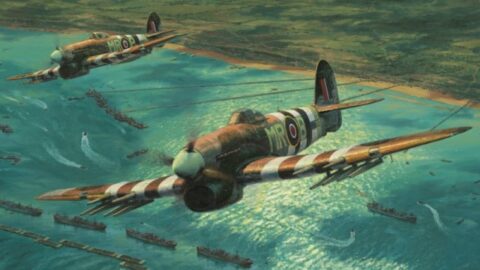
By 1944, Typhoons were equipped with RP-3 rockets capable of penetrating the armor of even heavily protected German tanks. Their low-level attack runs proved especially effective during the Allied invasion of Normandy. This is where they disrupted supply lines and inflicted heavy losses on retreating enemy forces. German troops quickly learned to fear the aircraft’s distinctive roar- often diving for cover at the mere sound of an approaching Typhoon overhead.
Its battlefield effectiveness earned it a reputation as one of the most feared Allied aircraft in the European Theater. What began as a troubled interceptor ultimately became one of the most successful fighter-bombers of the war. The Hawker Typhoon played a crucial role in Allied ground operations, demonstrating how adaptability in design and doctrine could transform failure into triumph.