

Why the US Can’t Simply Take the Strait of Hormuz
YouTube / CBC News
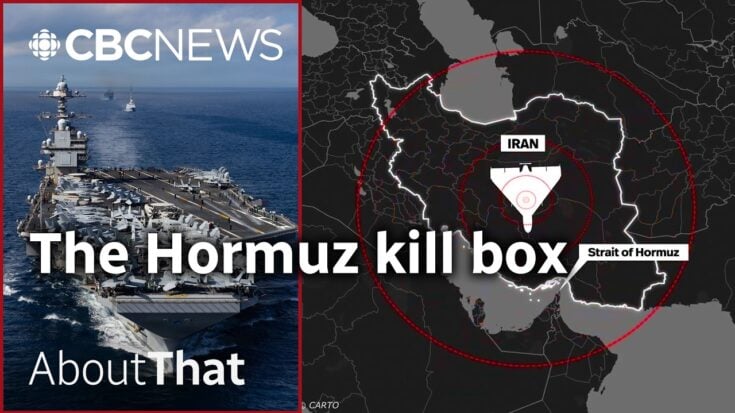
The United States has eleven aircraft carrier strike groups, hundreds of warships, and has been striking Iran continuously for nearly two weeks. The Strait of Hormuz is roughly 33 kilometers wide at its narrowest point. Twenty percent of the world’s daily oil supply moves through it. The US cannot reopen it. Understanding why requires understanding what kind of fight this actually is.
The Geography Works Against the Defender
The strait contains two designated shipping lanes deep enough for the world’s largest oil tankers. One lane in, one lane out, each three kilometers wide and three kilometers apart. Those dimensions create a precisely defined corridor that Iran doesn’t need to control. It only needs to make using it unacceptable.

Oil tankers are enormous, slow-moving targets traveling at 20 to 30 kilometers per hour through a predictable, confined route. They carry no defenses. Typical traffic runs roughly 3,000 ships per month, around 100 per day. Defending every one of them against attacks launched from Iranian soil a short distance away is a fundamentally different problem from conventional naval warfare.
The Weapons Iran Doesn’t Need a Navy For
The US has substantially degraded Iran’s conventional naval capacity. What remains is harder to eliminate because it doesn’t look like a navy. Shahed drones depending on the model have a theoretical range of up to 2,500 kilometers, meaning Iran can strike the strait from virtually any point inside the country. A drone carrying a 100-pound warhead costing tens of thousands of dollars to produce can strike a tanker worth hundreds of millions. That cost asymmetry does not favor the defender.

Short-range rockets, coastal artillery, and small boat swarms can be launched from inside Iranian territory with minimal warning time. Against attacks originating that close to the target, American warships might have seconds rather than minutes to detect, track, identify, and intercept incoming threats. The entire detection-to-interception sequence that works reliably against slower, longer-range threats compresses to the point where it may not work at all.
Mines present a separate problem. Placing a small number of mines in the shipping lanes is cheap, fast, and produces effects that outlast the mines themselves. Once an area has been mined, commercial shipping and insurance markets treat it as mined indefinitely regardless of subsequent clearance operations. The uncertainty alone is enough to halt traffic.
The Insurance Problem
The tankers sitting idle outside the strait are not waiting because they cannot physically transit. They are waiting because their insurance policies have been suspended or cancelled for strait transits. Insurance markets responded to the threat environment faster than military operations can address it. For commercial shipping to resume, the US would need to create conditions convincing enough that corporations, not just governments, decide the risk is acceptable.

That threshold requires far more than naval escorts. It requires suppressing Iran’s drone capability, neutralizing coastal launch sites, clearing mines, and sustaining that suppression long enough for insurance markets to recalibrate. Analysts describe it as requiring potentially the comprehensive destruction of Iran’s remaining military strike capability, not a convoy protection mission.







