How an F-35 Got Hit by an Iranian Missile in Operation Epic Fury
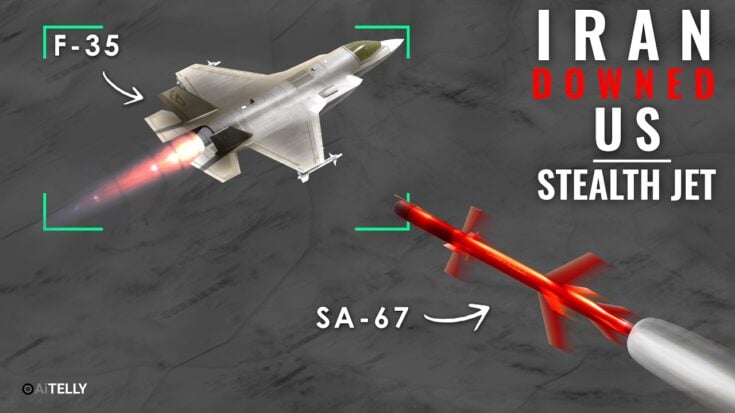
YouTube / AiTelly
The F-35 was designed to be nearly invisible to radar. That capability is genuine and has defined how the aircraft operates in contested airspace throughout Operation Epic Fury. It is also irrelevant to the weapon that likely hit it on March 19.
The Fundamental Vulnerability
The F-35’s stealth works by reducing its radar cross-section to an extraordinarily small profile. Its geometry and radar-absorbing materials make it effectively invisible to the long-range early warning and targeting radars that guide expensive surface-to-air missile systems like the S-300. Against those threats the aircraft performs as advertised.

The problem is heat. The F-35 is powered by a single Pratt and Whitney F135 engine, one of the most powerful fighter engines ever produced. That engine generates a substantial heat plume regardless of how small the aircraft’s radar signature is. Infrared search and track systems don’t use radar. They scan the sky passively for heat anomalies. Because they emit no energy, the F-35’s radar warning receivers cannot detect that the aircraft is being tracked. The pilot receives no indication that a targeting solution is developing until the missile is already in the air.
How the Engagement Likely Unfolded
Once an infrared-guided missile launches, the F-35’s Distributed Aperture System takes over. Six infrared cameras positioned around the airframe provide a full 360-degree view and detect the heat signature of the incoming missile’s rocket motor, alerting the pilot. At that point the response is high-G evasive maneuvering combined with flare deployment.

Flares are pyrotechnic countermeasures that burn at temperatures exceeding the aircraft’s engine exhaust, designed to overwhelm the missile’s infrared seeker and draw it toward the decoy heat source. If the missile tracks the flares but detonates within lethal proximity, its warhead fragments and shockwave can damage control surfaces, stealth coatings, and internal systems without destroying the aircraft outright. That outcome aligns directly with what was reported: an aircraft that was hit, sustained damage, and still made it back to base with the pilot alive.
The Weapon Behind It
Iran’s most likely candidate for this engagement is the Shahed-358, a hybrid between a loitering munition and a surface-to-air missile. It flies at subsonic speeds and can loiter in a designated airspace in a figure-eight pattern, using optical and infrared sensors to detect targets. Because it uses passive infrared guidance rather than radar, it operates entirely outside the electromagnetic spectrum the F-35 was optimized to defeat. Short range is its primary limitation.

But in an environment where F-35s are conducting repeated strikes deep into Iranian territory, isolated short-range systems concealed in terrain remain a persistent threat regardless of how degraded Iran’s broader air defense network has become.
Why F-35s Are Still Flying the Most Dangerous Missions
Iran’s integrated air defense network has been substantially dismantled. S-300 batteries, radar installations, and command nodes were among the earliest targets of the campaign. Tomahawk cruise missiles launched from destroyers in the Persian Gulf carved corridors through the air defense architecture before manned aircraft followed. Miniature Air Launched Decoys overwhelmed surviving radar operators with false targets while stealth aircraft penetrated behind them.
But network destruction is not total destruction. Isolated batteries and short-range systems can survive a campaign that eliminates the central architecture, operating independently and waiting for targets to enter their limited engagement envelope. For a non-stealth aircraft like the F-15E, a single surviving radar-guided battery represents a potentially fatal threat. For the F-35, the radar-guided threat is manageable. The infrared threat is the remaining problem, and the March 19 incident is the clearest evidence yet that Iran understands exactly where that vulnerability lies.