Watch WWII Footage: B-25s Unleash Devastating Air Assault on Cape Gloucester
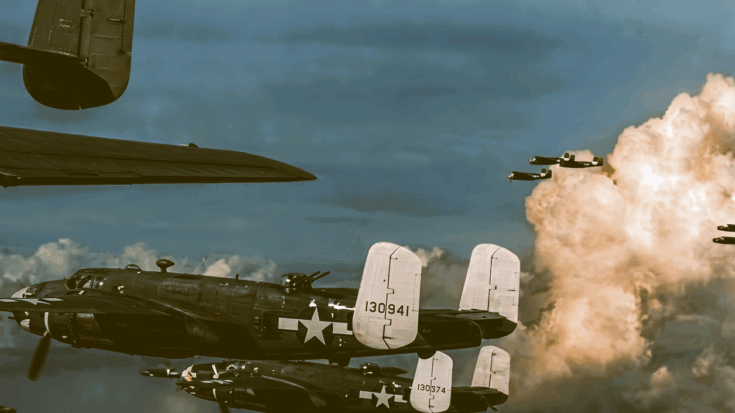
In December 1943, Allied forces turned their attention to the western end of New Britain, where dense jungle and heavy rain concealed a network of Japanese positions. The planned assault on Cape Gloucester formed part of a wider effort to isolate the major base at Rabaul and secure vital sea routes in the region. Before troops could land, however, the area had to be weakened from the air. Medium bombers, especially the B-25 Mitchell, became central to this effort, carrying out repeated strikes that reshaped the battlefield in the days leading up to the invasion.
The campaign unfolded during a period when air power in the Pacific had become more aggressive and precise. Allied commanders relied on sustained bombardment to disrupt supply lines, damage airfields, and reduce defensive strength. Cape Gloucester, with its airstrips and coastal positions, was seen as a key target. Control of this area would help secure nearby straits and support further advances toward the Philippines.
The Build-Up of the Air Offensive
Throughout early December, Allied aircraft began attacking targets across western New Britain. These operations included strikes on airfields, supply depots, and coastal shipping. B-25 bombers, often flying at low altitude, worked alongside heavier B-24s and lighter attack aircraft. Together, they formed a steady stream of sorties that increased in intensity as the invasion date approached.
By mid-December, the pace of attacks had grown more aggressive. Bombers struck villages and transport routes, aiming to cut off movement along the coast. These missions were not isolated raids but part of a coordinated plan to weaken defenses over time. Aircraft crews faced difficult weather, limited visibility, and strong ground fire, yet continued to press their attacks with regularity.
Peak Bombardment Before the Landings
The most intense phase of the air campaign came just days before the amphibious landing. On December 24, Allied forces launched a large-scale bombardment involving nearly 190 aircraft in a single day. Bombs fell across airfields, shore defenses, and inland positions, leaving the landscape scarred and disrupted.
This pressure continued into December 25, when attacks were carried out almost without pause. Waves of bombers struck throughout the day and night, targeting anything that could support a defense. The goal was not only destruction but also confusion, forcing defenders to remain under constant threat. By this stage, the sound of engines and explosions had become a near constant presence over Cape Gloucester.
B-25s and the Day of the Assault
On December 26, the long-planned landing began. As troops approached the shore, aircraft once again filled the sky. More than 270 bombers and attack planes supported the operation, striking areas between Cape Gloucester and nearby bays. The bombardment aimed to cover the advancing landing craft and suppress any remaining resistance.
The B-25 played a distinct role during these attacks. Many had been modified for low-level missions, carrying forward-facing machine guns that allowed them to strafe targets before releasing bombs. This approach proved effective against airfields, supply dumps, and troop positions hidden near the coast. The aircraft’s flexibility made it a valuable tool in the final stages of the assault.
Aftermath and Strategic Impact
Following the landings, air attacks continued to support ground forces as they moved inland. The capture of the Cape Gloucester airfields, though slowed by terrain and weather, marked a key objective of the operation. Engineers later worked to repair the damaged runways, which had been heavily cratered during the bombardment.
The campaign demonstrated how sustained air power could shape conditions before and during an invasion. By the time troops reached the shore, the defenses they faced had already been weakened by weeks of continuous attack.