French Rafales Have Shot Down Around 60 Iranian Drones Over the UAE
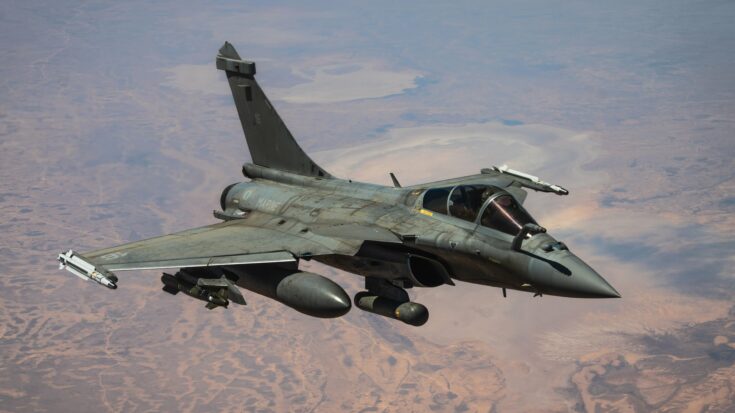
French Rafale fighter jets have shot down approximately 60 Iranian drones over the United Arab Emirates since operations began, according to reporting from La Tribune. France confirmed the defensive missions on March 4 when Foreign Minister Jean-Noël Barrot stated that French jets had neutralized drones targeting the UAE. The pace of those intercepts has created a problem that extends well beyond French air power.
The Cost Problem
MICA air-to-air missiles cost between €600,000 and €700,000 per unit. The Shahed drones being intercepted cost between $30,000 and $50,000 each. Shooting down 60 drones with MICA missiles represents a cost exchange ratio that is unsustainable at scale, and La Tribune reports that French missile stocks have been depleted faster than anticipated as a result.

The scale of the threat helps explain the consumption rate. On March 14 alone, UAE air defenses intercepted nine ballistic missiles and 33 drones launched from Iran in a single day. Since the start of Iranian attacks the UAE has intercepted 294 ballistic missiles, 15 cruise missiles, and 1,600 drones in total. Against that volume of incoming fire, expensive air-to-air missiles are the wrong tool economically even when they work perfectly.
The Search for Cheaper Solutions
France’s defense procurement agency the DGA is actively testing lower-cost intercept options including rockets, anti-drone drones, cannon fire, and machine guns. The French Ministry of Armed Forces has identified 68mm laser-guided rockets, specifically the Aculeus-LG used on the Tiger attack helicopter, as a potentially viable counter-drone option. The caveat is that effectiveness against moving targets has not yet been demonstrated.
France is not working on this problem alone. Belgium is testing Thales Belgium’s FZ275 LGR, a semi-active laser-guided 70mm rocket, on F-16s for counter-drone missions. In early March a Royal Air Force Typhoon was photographed at BAE Systems’ Warton site carrying LAU-131 rocket pods capable of firing APKWS guided rockets, suggesting the RAF is pursuing the same approach. Multiple NATO air forces have arrived at the same conclusion simultaneously: the current cost exchange ratio is not viable for a prolonged conflict involving mass drone attacks.
The underlying arithmetic is straightforward. A nation can produce Shahed-type drones in quantity at minimal cost and exhaust an opponent’s expensive missile inventory faster than it can be replenished. Solving that problem requires either cheaper intercept weapons, different intercept methods, or both.