Inside the Animal Guided Bombs of WW2
YouTube / Blue Paw Print
World War II pushed scientists and engineers to think in completely new ways. Nations were racing to build better planes, stronger tanks, and more powerful weapons. But some of the strangest ideas of the war did not rely on advanced electronics or complex machines.
Instead, they relied on animals.
In several experimental programs, animals were trained or used to guide weapons toward enemy targets. Military researchers believed that animals’ natural instincts could be used to solve problems that technology at the time could not easily fix. From dogs trained to destroy tanks to pigeons guiding bombs in flight, these unusual ideas reveal just how far scientists were willing to go during wartime.
Soviet Dogs Against German Tanks
One of the most well-known animal weapon programs took place in the Soviet Union. As German armored divisions pushed deep into Soviet territory, Soviet forces struggled to stop the powerful German tanks. To counter this threat, Soviet trainers developed a program using dogs. The dogs were trained to run underneath enemy tanks while carrying explosives attached to their bodies. The idea was that when the dog moved beneath the tank, the explosive would detonate and destroy the vehicle.
Training involved teaching the dogs to associate tanks with food, encouraging them to run toward them. In theory, the system could allow Soviet forces to destroy tanks without risking soldiers in close combat. However, the reality was far more complicated. The noise, confusion, and danger of the battlefield often caused the dogs to panic or behave unpredictably, making the tactic unreliable.
America’s Unusual Bat Bomb
In the United States, another unusual idea was being tested: the bat bomb. Researchers believed that bats could carry small incendiary devices and be released over enemy cities. Because bats naturally seek dark places to rest, they would fly into buildings, attics, and rooftops.
Once inside, timed incendiary devices would ignite, starting fires across a wide area. The concept was designed with Japan in mind, where many buildings were made largely of wood and paper. If the bats scattered across a city and ignited multiple fires at once, the damage could be greater than that caused by a single conventional bomb. Although the project showed some promise during testing, it was eventually abandoned before it could be used in combat.
Project ORCON: The Pigeon-Guided Bomb
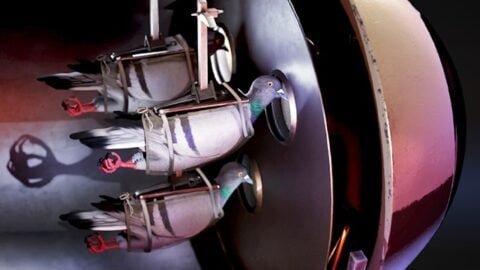
Perhaps the most unusual animal weapon proposal came from American psychologist B. F. Skinner. His idea, known as Project ORCON, involved training pigeons to guide bombs toward their targets. Inside the nose of a glide bomb, pigeons would be placed in a small compartment facing a screen that displayed the target below. The birds were trained to peck at the image of the target.
Each time the pigeon pecked the correct spot, the system would adjust the bomb’s direction to stay on course. Skinner believed that pigeons, with their sharp eyesight and ability to recognize patterns, could guide weapons with surprising accuracy. Early tests suggested the idea might actually work. Despite promising results, the military ultimately decided not to continue the project.
Innovation or Desperation?
These unusual experiments demonstrate the desperate and creative nature of wartime research. Engineers were searching for any advantage that might help defeat the enemy, even if it meant turning animals into part of a weapon system. Some of these programs produced useful insights, while others proved too unpredictable or impractical to continue.
The story of animal-guided weapons highlights an uncomfortable truth about war. When survival is at stake, governments and scientists may explore ideas that seem strange, risky, or ethically questionable. While most of these programs never gained widespread use, they remain a fascinating reminder of the unusual paths wartime innovation can take.