The Largest Aircraft Ever to Land on an Aircraft Carrier
YouTube / Jan Tomášek
In the early Cold War years, the U.S. Navy faced a serious logistical problem. The new generation of supercarriers, led by USS Forrestal in 1955, could operate far from land for extended periods. What they lacked was a reliable way to resupply those ships at sea using aircraft. Existing carrier aircraft simply did not have the range or payload to solve the problem.
That challenge led to one of the most unlikely experiments in naval aviation history.
Why the C-130 Was Considered
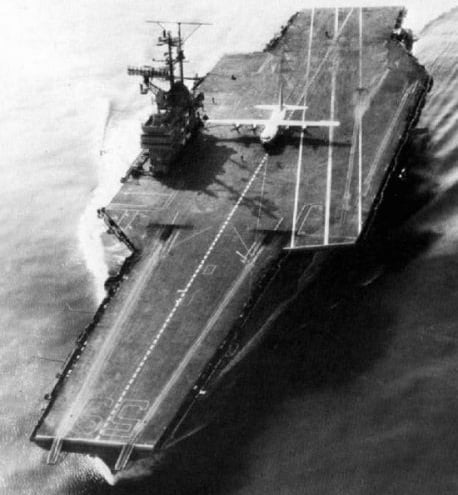
The Lockheed C-130 Hercules was never designed for carrier operations. It was large, heavy, and built for long range transport missions. Yet its short takeoff and landing performance made it a candidate worth testing. The Forrestal class flight deck measured just over 1,000 feet long and about 250 feet wide. On paper, that was barely enough space for a C-130 to attempt a landing.

The idea was simple. If the Hercules could land, unload cargo, and take off again without catapults or arresting gear, it could solve the carrier resupply problem in a single stroke.
An Unusual Choice of Pilots
Another issue quickly surfaced. C-130 pilots had no experience landing on aircraft carriers. Navy fighter pilots, on the other hand, were carrier qualified but had never flown a Hercules. The Navy chose the latter. Fighter pilots were trained to judge deck motion, approach angles, and visual cues under pressure, and the Navy decided those skills mattered more than aircraft familiarity.

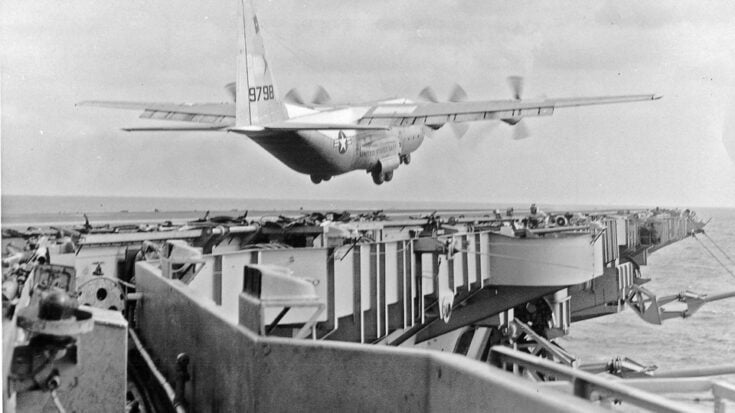
In 1963, testing began aboard USS Forrestal using a specially modified C-130F.
Results That Defied Expectations
Over three days, the aircraft completed 29 touch and go landings and 21 full stop landings. The results were remarkable. The C-130 consistently stopped in about 267 feet and successfully took off without assistance while weighing more than 55 tons. No arresting cables were used. No catapults were involved.

From a technical standpoint, the tests were an undeniable success.
Why It Was Never Adopted
Despite the impressive performance, the Navy ultimately rejected the concept. The margin for error was too small, deck operations would be severely restricted, and the risk to ship and crew was unacceptable during routine operations. Instead, the Navy chose a purpose-built solution, the C-2A Greyhound, which balanced payload, safety, and operational practicality.
The C-130 carrier tests remain a rare example of what was technically possible but operationally impractical.