

P-39 vs A6M vs Bf 109
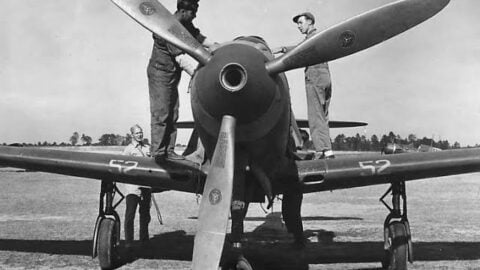
YouTube / Greg's Airplanes and Automobiles
During World War II, few air combat matchups were as influential as those involving the American Bell P-39 Airacobra, the Japanese Mitsubishi A6M Zero, and the German Messerschmitt Bf 109.
Each aircraft reflected its nation’s doctrine and industrial priorities, producing three very different fighters that clashed across multiple theaters. While none was universally superior, their strengths and weaknesses defined the air war in Europe and the Pacific.
Speed and Power
The Messerschmitt Bf 109 generally held the edge in speed and climb rate. Powered by increasingly refined Daimler-Benz engines, later variants could exceed 640 km/h and climb rapidly to intercept enemy bombers. The Bell P-39 Airacobra, by contrast, had a respectable top speed but suffered at high altitude due to its lack of a turbocharger.
Its mid-engine layout gave it strong acceleration at low altitude, making it dangerous in ground-attack roles and low-level dogfights. The Mitsubishi A6M Zero was lighter and extremely efficient, giving it excellent range and low-speed performance, but it lacked the raw engine power of its adversaries.
Maneuverability and Dogfighting
In terms of agility, the Mitsubishi A6M Zero was unmatched early in the war. It could out-turn nearly any opponent, including the P-39 and early Bf 109 models. However, this came at the cost of armor protection and structural strength.
The P-39 was highly maneuverable at low altitude and could surprise opponents with tight turning ability in certain conditions, though it was not as consistent as the Zero. The Bf 109, while not as nimble in sustained turning fights, excelled in energy-fighting tactics, boom-and-zoom attacks that relied on speed and altitude advantages rather than tight dogfighting.
Firepower and Durability
The P-39 stood out for its heavy armament, featuring a 37mm cannon firing through the propeller hub, making it devastating in a single hit. The Bf 109 also carried strong firepower, typically combining a motor cannon with machine guns.
The Zero, however, relied on lighter armament but compensated with accuracy and pilot skill. In durability, both the P-39 and Bf 109 were significantly more robust than the lightly built Zero, which prioritized agility over protection.
Operational Effectiveness
Each aircraft thrived in environments suited to its design. The P-39 performed well with Soviet pilots on the Eastern Front, where combat occurred at lower altitudes. The Bf 109 dominated European skies through disciplined tactics and high-altitude performance. The Zero ruled early Pacific engagements but gradually declined as Allied aircraft improved in speed, armor, and firepower.
Conclusion
The clash between the P-39, Zero, and Bf 109 was not simply about which aircraft was best overall, but which was best suited to its role. Each fighter represented a distinct philosophy of air combat that shaped the outcome of aerial warfare in WWII.







