

How She Saved Spitfires During WW2
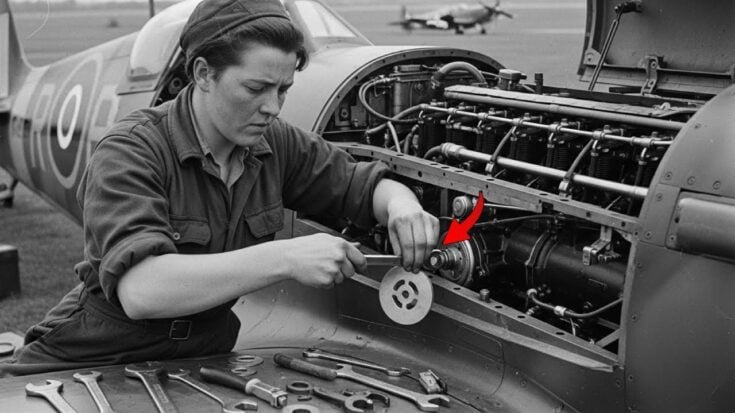
YouTube / WW2 Records
During the Battle of Britain, RAF pilots discovered a flaw that their opponents were actively exploiting. Every time a Spitfire or Hurricane pushed into a dive, the Rolls-Royce Merlin engine cut out. The SU carburetor flooded under negative G forces, starving the engine of fuel for up to 1.5 seconds. German Bf 109s used direct fuel injection and had no such limitation. Luftwaffe pilots learned to dive away from pursuing British fighters knowing the Merlin would cut out the moment the RAF pilot followed.
Beatrice Shilling had been working on the problem since the issue was identified in 1940.
The Engineer
Shilling joined the Royal Aircraft Establishment in 1936, initially as a technical author. On November 1, 1939, she was promoted to technical officer in charge of carburetor research and development, later rising to principal technical officer.

Outside Farnborough, she was one of only three women in history to earn the British Motorcycle Racing Club Gold Star for lapping the Brooklands circuit at over 100 mph on a motorcycle.

The Fix
Shilling designed a thimble-shaped brass flow restrictor with precisely calculated dimensions to allow just enough fuel flow for maximum engine power. The design was later refined to a simplified flat brass washer. It was installed in the fuel line ahead of the carburetor, limiting maximum fuel flow enough to prevent flooding during negative G maneuvers without starving the engine at full throttle.

During early 1941, Shilling traveled with a small team to fit the restrictors at one RAF base after another, giving priority to front-line units. By March 1941 the device had been installed throughout RAF Fighter Command.
The nickname Miss Shilling’s Orifice was coined by Sir Stanley Hooker, the engineer who led supercharger development at Rolls-Royce. Shilling accepted it without complaint.

The Result
The restrictor remained in service as a stopgap until the introduction of the pressure carburetor in 1943. Keith Maddock, chief engineer at Hangar 42 during the war, later told the BBC: “Beatrice Shilling helped us to win World War II. Of that there is no doubt.”

After the war Shilling continued at Farnborough, working on the Blue Streak missile program, researching wet runway braking effects, and helping design a bobsled for the RAF Olympic team. She received the OBE in 1949 and retired in 1969. She died on November 18, 1990, aged 81.







