The Forgotten British Weapon That Destroyed German Aircraft Without Being Seen
YouTube/ WW2 BRITISHFRONT
In the dark early years of the Second World War, Britain faced a relentless aerial threat from German bombers. Night after night, the Luftwaffe struck cities and ports, often slipping through defenses that relied heavily on visual tracking and timed explosions. Anti-aircraft gunners could fire thousands of shells, yet many would burst harmlessly in the empty sky.
Britain needed something smarter, something that could think for itself in the air. What emerged from secret laboratories was a weapon so advanced that it seemed almost impossible for its time: the proximity fuse, a tiny device that allowed shells to detonate automatically when near an aircraft. It was invisible, revolutionary, and devastatingly effective.
A Radical Idea Takes Shape
The concept behind the proximity fuse was simple in theory but incredibly difficult in practice. Instead of relying on timers or direct hits, engineers wanted a shell that could detect when it was close to an aircraft and explode at the perfect moment. The challenge was enormous. Any electronic device inside an artillery shell had to survive extreme conditions, including the violent force of being fired from a gun. This meant enduring accelerations of up to 20,000 times the force of gravity.
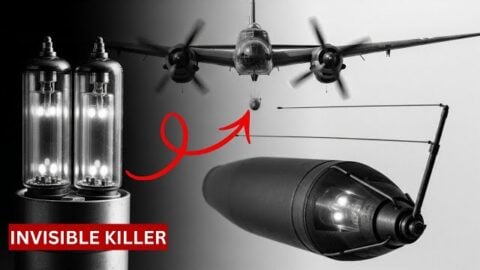
At Britain’s secret research facilities in Malvern, scientists worked tirelessly to overcome these obstacles. They developed a miniature radar system small enough to fit inside a shell just a few centimeters wide. This tiny device would emit radio waves and detect reflections from nearby aircraft, triggering an explosion when the target came within roughly 15 meters.
Engineering the Impossible
Creating a working proximity fuse pushed the limits of 1940s technology. Vacuum tubes had to be ruggedized to survive intense shock, circuits had to be compact and reliable, and the entire system had to function flawlessly in a fraction of a second. The result was a marvel of engineering: a fuse barely 7 centimeters long that could detect a target and detonate in about three-thousandths of a second.
This level of precision transformed anti-aircraft warfare. Instead of requiring a direct hit, gunners now only needed to get close. A near miss was suddenly enough to destroy or severely damage an aircraft, dramatically increasing the effectiveness of every shell fired.
The Secret War in the Sky
The proximity fuse was deployed with extreme secrecy. British defenses began using it during critical periods of the war, including the defense of key cities like Portsmouth. Almost immediately, its impact was felt. German bombers that once flew with relative confidence through anti-aircraft fire now faced a deadly and unpredictable threat.
From the Luftwaffe’s perspective, something had changed, but they could not understand what. Aircraft were being destroyed by shells that seemed to explode with uncanny accuracy. There was no visible guidance system, no obvious improvement in British gunnery, just a sudden and alarming increase in losses.
A Weapon That Changed Everything
The proximity fuse quietly revolutionized air defense. It turned anti-aircraft artillery from an imprecise deterrent into a lethal and efficient weapon system. While it remained largely hidden from public view during the war, its influence was undeniable. By dramatically improving the odds of hitting fast-moving aircraft, it helped protect British cities and weakened the effectiveness of German bombing campaigns.
In the end, this unseen weapon proved that sometimes the most powerful innovations are not the largest or most visible, but the ones working silently behind the scenes, changing the course of war without ever being seen.