

The Weirdest Bomb the Allies Ever Dropped
YouTube / Dark Skies
By the final months of World War II, Allied air forces had developed an arsenal capable of destroying almost anything. Massive “blockbuster” bombs flattened cities, while specialized weapons like the Tallboy bomb could penetrate deep into reinforced targets before detonating. Yet some structures proved maddeningly resilient. Among them was the heavily fortified Schnellboot bunker known as “BY,” a hardened German naval installation designed to shelter fast-attack boats from aerial attack.
Constructed from immense slabs of reinforced concrete, the bunker was built to withstand direct hits. Repeated bombing raids left little more than scorch marks and superficial damage. Even the Tallboy, famous for collapsing tunnels and shattering submarine pens, failed to achieve a decisive breakthrough. The Allies needed something entirely different.
Enter the Unlikely Solution
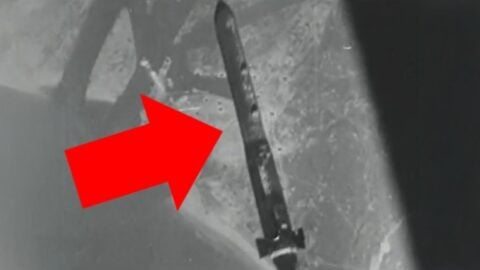
On a hazy morning in February 1945, nine B-17 Flying Fortress bombers approached the target carrying one of the strangest weapons ever devised. Slung beneath their wings were long, narrow devices that looked more like oversized darts than bombs. Their unusual appearance hinted at the radical thinking behind them.
These weapons were known as “Disney bombs,” a name that seemed better suited to animation than to warfare. The nickname reportedly came from their experimental, almost fantastical concept, something that seemed as if it belonged in a cartoon rather than a battlefield.
How the “Disney Bomb” Worked
Unlike conventional bombs, the Disney bomb relied on a two-stage attack. After release from high altitude, the weapon would fall freely for several seconds, stabilized by fins to ensure a precise trajectory. This initial drop allowed it to build speed before the real innovation kicked in.
Roughly thirty seconds into the fall, the tail section would detach in a burst of smoke. Instantly, a cluster of rocket motors ignited, dramatically accelerating the bomb. Instead of slowing down as most bombs did due to air resistance, the Disney bomb surged forward, pushing past the speed of sound.
This extraordinary velocity gave it a critical advantage. The faster a bomb travels upon impact, the deeper it can penetrate before detonating. In theory, this meant even the thickest concrete defenses could be breached.
Breaking the Unbreakable
As the bombs slammed into the bunker, their supersonic speed allowed them to punch through layers of reinforced concrete that had previously resisted every known weapon. The delayed detonation ensured the explosion occurred deep within the structure rather than on the surface, maximizing internal damage.
While not all of the bombs performed perfectly, experimental weapons rarely do; the attack marked a turning point. For the first time, the supposedly invulnerable bunker suffered serious structural damage. The concept had worked: speed, rather than sheer explosive force alone, was the key.
A Weapon Ahead of Its Time
The Disney bomb remains one of the most unusual weapons of World War II. Its rocket-assisted design foreshadowed later developments in bunker busting technology, where penetration depth became as important as explosive yield.
Though it arrived late in the war and saw limited use, its success demonstrated the power of unconventional thinking. When traditional methods failed, engineers turned to innovation, creating a weapon that sounded whimsical but delivered very real results. In the end, the weirdest bomb the Allies ever dropped proved that even the strongest fortress could be overcome, not just with bigger explosions, but with smarter design.







