

Three U.S. Aircraft Destroyed at Forward Landing Site in Iran After High-Risk Airman Rescue
@andynovy / X
A Rescue Mission Under Extreme Pressure
Military officials have described a recent rescue operation in southern Iran as one of the most demanding recovery missions carried out by U.S. Special Operations forces in recent years. The effort focused on extracting an American airman stranded deep inside hostile territory after a fighter aircraft was lost during combat operations. Over a tense 48-hour period, hundreds of personnel worked across air, ground, and intelligence networks to prevent the airman from being captured while coordinating a safe recovery.
The incident began when an F-15E Strike Eagle went down south of Isfahan. The aircraft’s Weapons System Officer successfully ejected but landed in mountainous terrain far from friendly support. Injured during the escape, the airman immediately began moving to avoid detection. Officials later explained that survival depended on remaining hidden while rescue planners tracked shifting threats nearby. The situation quickly became a race against time as Iranian patrols moved into the region searching for the downed pilot.
Survival in Hostile Terrain
According to senior officials, the airman spent more than a full day evading capture under difficult conditions. Despite injuries, the officer climbed a ridgeline rising roughly 7,000 feet above the surrounding terrain to gain visibility and improve communication chances with surveillance aircraft. The climb also created distance from search teams operating below, reducing the likelihood of discovery during daylight hours.
The airman later sheltered inside a narrow mountain crevice, using natural cover to remain unseen. Intelligence assets monitored the area continuously, allowing rescue planners to maintain awareness of the airman’s location without revealing it to nearby forces. A senior administration official told Axios, “He was invisible to the naked eye. It was only through advanced CIA surveillance capabilities that we were able to maintain a lock on his position.” Maintaining secrecy became essential as enemy patrols closed in from several directions.
Building a Complex Recovery Operation
To prevent capture, the Pentagon organized a large recovery mission involving multiple military branches. Elite personnel, including members of U.S. Naval Special Warfare Development Group, supported by hundreds of additional troops, prepared for an insertion into contested territory. Fighter jets and attack aircraft formed what officials described as a protective air umbrella, circling the extraction zone to discourage approaching ground forces.
Aircraft conducted precision strikes against vehicles believed to be moving toward the hiding location. These actions slowed advancing units while avoiding prolonged direct combat. Commanders emphasized that the objective remained recovery rather than escalation, and forces attempted to limit sustained engagements. Intelligence coordination, aerial surveillance, and rapid communication between units allowed planners to adjust movements in real time as conditions changed across the mountainous region.
Crisis at the Extraction Site
The most dangerous phase unfolded after rescue aircraft reached a remote landing strip prepared for evacuation. Transport planes, believed to include HC-130J Combat King II rescue aircraft, landed successfully and secured the airman along with special operations teams. Shortly afterward, mechanical problems disabled two of the aircraft on the ground, creating a new risk that sensitive equipment could be captured.
Commanders responded by ordering reinforcements to the site. Three additional transport aircraft were redirected to complete the evacuation while security teams protected the landing zone. All personnel, including the rescued officer, were transferred to the replacement aircraft under pressure as nearby forces continued moving toward the area. The operation required rapid coordination to avoid delays that could have exposed the mission to further danger.
Destroying Equipment to Prevent Capture
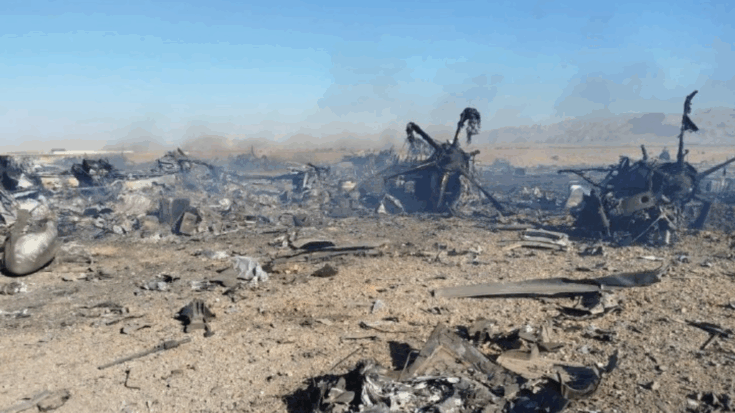
After evacuation was complete, U.S. forces destroyed the disabled aircraft to deny access to advanced technology. Explosives and airstrikes reduced the transports to wreckage before departing units left Iranian airspace. Images later showed the remains of aircraft debris, including what analysts identified as an MH-6 Little Bird helicopter positioned near destroyed rescue planes.
Military planners have historically used such denial measures when recovery is impossible, reflecting long-standing doctrine aimed at protecting sensitive systems. Officials confirmed the rescued Weapons System Officer is now receiving treatment at an undisclosed U.S. facility. The airman is able to walk, though medical teams continue evaluating injuries sustained during ejection, prolonged evasion, and the demanding climb through mountainous terrain.






