Watch: U.S. Strikes Destroy Iran’s RQ-170 Drone Clone in New CENTCOM Footage
@Archer83Able / X
A Modern Conflict Seen Through Drone Cameras
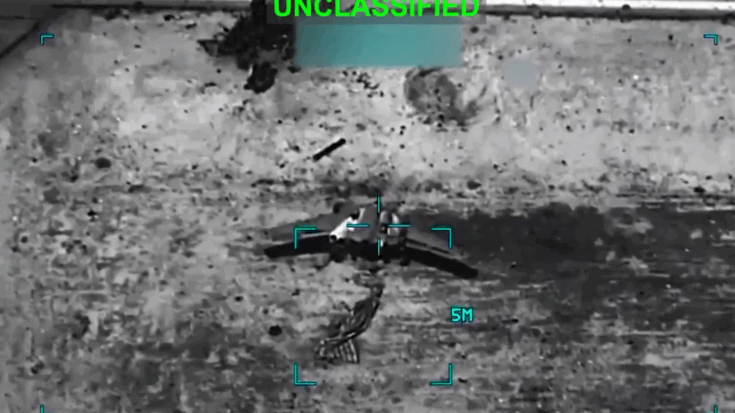
New footage released by U.S. Central Command (CENTCOM) offers a rare public look at modern aerial warfare, showing precision strikes against several Iranian military systems, including what analysts identify as a reverse-engineered clone of the American RQ-170 Sentinel drone. Shared on April 2, 2026, the video quickly drew attention because of the aircraft’s distinctive flying-wing shape, a design long associated with stealth reconnaissance technology.
The destroyed aircraft appears similar in size and structure to the original RQ-170, featuring a compact body and two raised sections along the wings. Defense observers noted these details match known images of Iranian copies developed after a U.S. drone crashed inside Iran roughly fifteen years earlier. CENTCOM released the footage during the fifth week of an ongoing military campaign, framing the strikes as part of broader efforts targeting air defenses and military infrastructure.
What the Strike Video Reveals
The video follows a familiar format used in previous CENTCOM releases. Targets are illuminated by a laser designator moments before impact, suggesting the use of precision-guided weapons launched from remotely piloted aircraft. Analysts believe the recording may have come from an MQ-9 Reaper’s electro-optical and infrared sensor system, commonly used for surveillance and strike coordination.
Alongside the drone, the footage shows the destruction of a light tactical vehicle and a surface-to-air missile launcher believed to resemble Iranian systems derived from the Russian Buk-M2 design. Admiral Brad Cooper, commander of CENTCOM, said in the official statement: “Now in our 5th week of the campaign, it is my operational assessment that we are making undeniable progress. We don’t see their navy sailing. We don’t see their aircraft flying, and their air and missile defense systems have largely been destroyed.”
Some observers questioned whether at least one target may have been a decoy, noting the absence of secondary explosions typically caused by missile fuel or stored warheads. The video cuts away before debris settles, leaving final damage assessments unclear, a common limitation in publicly released strike recordings.
The Origins of the Drone Clone
The aircraft shown in the footage traces its history back to December 2011, when an American RQ-170 Sentinel operating near the Afghan border was lost and later recovered inside Iran. Iranian officials claimed electronic warfare techniques disrupted the drone’s navigation signals, forcing it to land. Other explanations suggested a technical malfunction may have caused the aircraft to descend intact.
The RQ-170 itself is a low-observable reconnaissance drone introduced in 2007 and used for intelligence gathering in contested regions. Its flying-wing layout reduces radar visibility while carrying advanced sensors designed to observe ground activity from high altitude. Only limited details about its capabilities have ever been officially released.
By 2014, Iran publicly displayed what it described as a locally produced copy, later identified as the Shahed-171 Simorgh. The system represented an effort to replicate the captured aircraft through reverse engineering, leading to several related designs over the following decade.
Development and Evolution Over Time
Promotional videos released in later years showed assembly processes involving composite materials, electronics installation, and both propeller-driven and jet-powered variants. These aircraft were presented as reconnaissance and strike platforms capable of carrying precision weapons internally rather than on external pylons. Analysts noted that the drones appeared smaller and simpler than the American original but retained its recognizable outline.
Additional variants, including the smaller Shahed-191 Saeqeh, demonstrated how the design evolved into multiple configurations intended for surveillance and limited attack roles. Some footage released by Iranian media also showed the drones being launched from vehicles and used in regional operations, though independent verification of combat effectiveness has remained limited.
The CENTCOM strike footage therefore captures more than a single battlefield event. It highlights a technological cycle in which advanced systems are studied, replicated, and eventually targeted again years later, reflecting how modern military innovation spreads across conflicts and continues to shape aerial warfare in the twenty-first century.