Shark-Mouth A-10s Head to the Middle East as Warthog Missions Expand
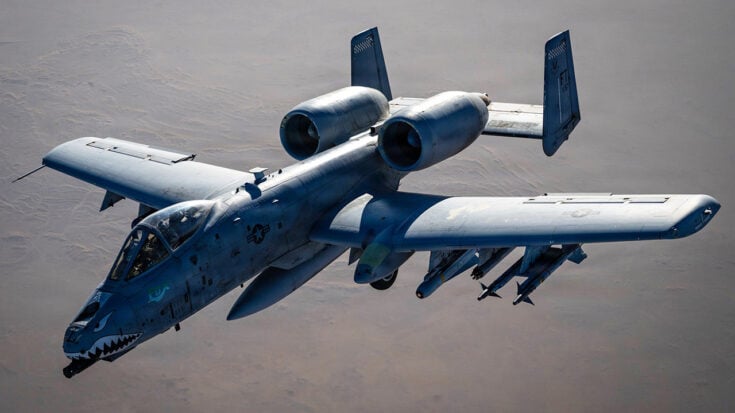
Two A-10C Thunderbolt II aircraft from the 74th Fighter Squadron departed RAF Lakenheath in April 2026, continuing toward the Middle East. Unlike typical deployments of 10 to 12 aircraft, this movement involved just two jets, supported by tanker aircraft.
The smaller size stands out. It suggests a targeted deployment rather than a full rotation, possibly tied to recent operational losses or specific mission needs.
The Return of a Familiar Marking
These aircraft carry the shark mouth nose art associated with the 23rd Fighter Group. The marking traces back to the American Volunteer Group, which used it on P-40 fighters in 1941.
Today, only this group is authorized to carry the design. Its presence on modern A-10s connects current operations to a lineage that began in the early days of World War II.
U.S. Air Force A-10 Thunderbolt II’s receive fuel in-flight while supporting Operation Epic Fury. The A-10 Thunderbolt II can loiter for hours, standing by and ready to execute a mission whenever needed. pic.twitter.com/VjESHLR32Y
— U.S. Central Command (@CENTCOM) March 15, 2026
Possible Replacement After Combat Loss
The timing of the deployment follows a reported loss of an A-10 during a combat search and rescue mission tied to a downed F-15E Strike Eagle. While not officially confirmed, the two aircraft may be replacing that loss or reinforcing the existing force.
This would explain the limited size of the ferry group. One aircraft could serve as a replacement, while the other provides redundancy.
U.S. military sustainers are on top of their game. pic.twitter.com/EK9eqF4fc8
— U.S. Central Command (@CENTCOM) March 20, 2026
A-10 Roles in a Modern Conflict
The A-10 continues to operate across multiple mission types in current operations. In addition to close air support, it has taken on counter-drone and maritime roles.
Typical loadouts include AGM-65 Maverick missiles, AIM-9M Sidewinder missiles, and AGR-20 APKWS rockets. This combination allows engagement of both ground targets and small aerial threats such as drones.
The APKWS system stands out. It provides a lower-cost option for intercepting small targets, increasing the number of available shots compared to traditional missiles.
Coronet East 066 – Losses to be replaced #FreeIran
— Operation EPIC FURY —A single tanker from France is supporting the move of 2 additional A-10C “Thunderbolt II” attack aircraft to the Middle East this morning after their brief stay at RAF Lakenheath (EGUL).
KC-135R… pic.twitter.com/rNU6DlBs9F
— DefenceGeek 🇬🇧 (@DefenceGeek) April 20, 2026
From Close Air Support to Maritime Patrol
Recent operations show the A-10 expanding into maritime roles. Its ability to loiter at low speed, combined with accurate weapons delivery, makes it effective against fast attack craft and small surface threats.
This shift reflects a broader trend. Aircraft originally designed for ground support are adapting to new threats, including drones and small naval targets.