The Navy’s New JDAM-LR Turns a Simple Bomb Into a 200-Mile Strike Weapon

In early April 2026, the U.S. Navy tested a new version of its most widely used precision weapon. The Joint Direct Attack Munition Long Range, or JDAM-LR, completed two demonstration flights of roughly 200 nautical miles each. Both tests were carried out by F/A-18 Super Hornets, validating safe release, powered flight, and accurate navigation to target.
The goal is direct: Give carrier-based aircraft the ability to strike from greater distances without relying entirely on expensive cruise missiles.
A New Era for Precision Strike: JDAM LR Completes Milestone Test Flights
The U.S. Navy has successfully demonstrated the new JDAM Long Range variant, marking a huge step in bringing affordable, long-range standoff capabilities to the Carrier Air Wing.https://t.co/GvMomaPnSp pic.twitter.com/cNgEgnZGXy
— NAVAIR (@NAVAIRNews) April 20, 2026
From Gravity Bomb to Powered Munition
The standard JDAM converts unguided bombs into GPS-guided weapons. JDAM-LR goes further. It adds a small turbojet engine, fuel, and wings, turning a simple bomb into a powered, long-range strike system.
The current configuration uses a 500-pound Mk 82 warhead. Boeing states the system could reach beyond 300 nautical miles in its baseline form. A decoy version, replacing the warhead with additional fuel, could extend that range to roughly 700 nautical miles.
The key advantage is compatibility. JDAM-LR uses the same aircraft interfaces as existing JDAMs, allowing faster integration across current platforms.
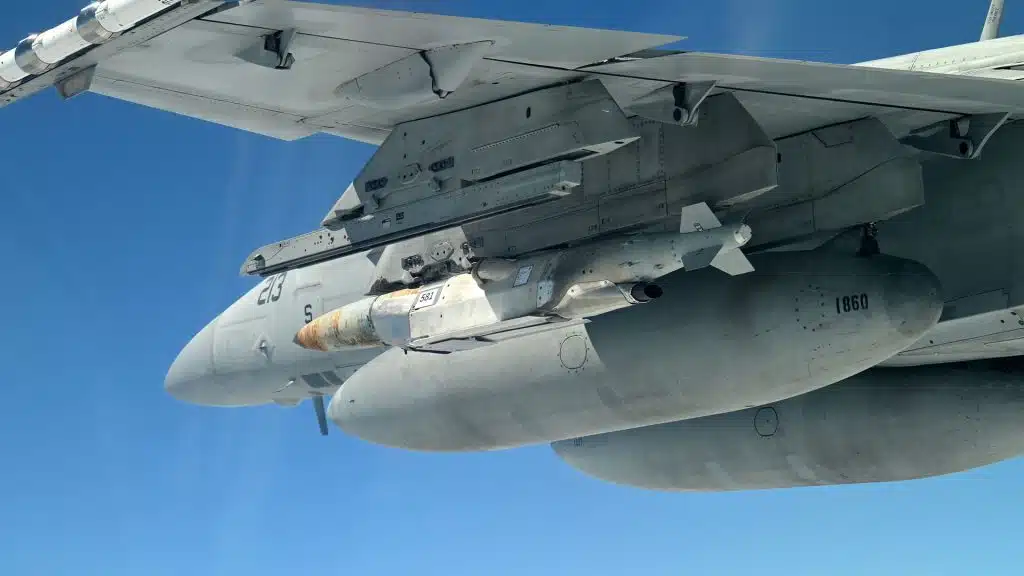
Designed for Carrier Operations
The next step focuses on carrier integration. Operating from a flight deck introduces stricter limits on storage, handling, and safety. If successful, the weapon would give carrier air wings a lower-cost option for long-range strike missions.
This matters in contested environments. Longer reach allows aircraft to remain farther from enemy air defenses while still delivering precision effects.
Where It Fits in the Arsenal
The U.S. Navy already fields long-range systems like Tomahawk, LRASM, and JASSM. JDAM-LR is not a replacement. It fills a different role.
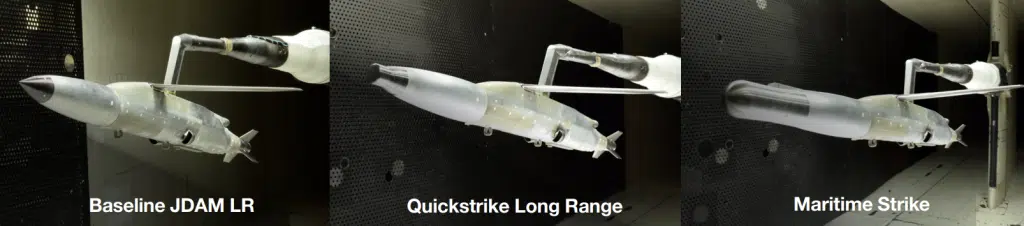
Its value comes from cost and scale. Compared to high-end missiles, it can be produced in larger numbers and used more flexibly. Planned variants, including anti-ship and aerial mining configurations, suggest broader applications across both naval and air operations.