The Most Abysmal Soviet Fighter of WW2
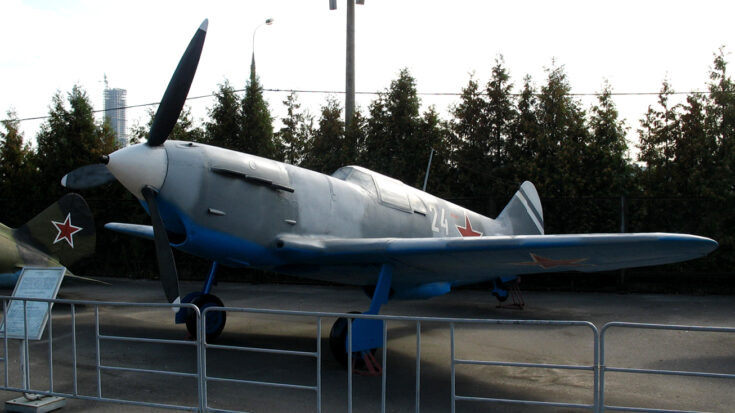
YouTube / IsonzoEnjoyer
A Fighter Shaped by Shortage
Early in the war on the Eastern Front, German fighter aces often faced Soviet aircraft that lagged behind in performance, reliability, and pilot confidence. One of the clearest examples was the Lavochkin Gorbunov Gudkov LaGG-3. Its design was driven less by ideal engineering and more by necessity. The Soviet Union faced a severe shortage of light alloys in 1940 and 1941, forcing designers to rely on alternative materials.

The LaGG-3 was built primarily from resin infused laminated wood known as Delta Drescina. While strong on paper, this construction method resulted in a heavy airframe. Weight quickly became the aircraft’s defining problem and shaped nearly every aspect of its performance.
Heavy Airframe, Weak Engine
Power came from the Klimov M-105 inline engine, which struggled to move the overweight fighter. The result was poor acceleration, limited climb rate, and disappointing speed at combat altitudes. Soviet pilots found the aircraft sluggish and unresponsive, particularly when compared to German Bf 109 variants operating in the same airspace.

Handling issues compounded these weaknesses. The LaGG-3 had a tendency to stall at low speeds and could enter spins during tight maneuvers. Recovering from these situations required altitude and experience, both of which were often unavailable during chaotic early war engagements. Rushed wartime production further affected build quality, leading to inconsistent performance across units.
Survivability and Numbers
Despite its flaws, the LaGG-3 was not entirely without value. Its wooden structure could absorb a surprising amount of battle damage, allowing some pilots to return from missions that would have destroyed lighter aircraft. More importantly, the Soviet Union produced over 6,500 examples. At a time when losses were extreme, having aircraft available mattered as much as having ideal ones.

From Failure to Foundation
The LaGG-3’s story did not end in failure. When designers replaced the underpowered inline engine with the much stronger M-82 radial, the aircraft was transformed. That redesign became the Lavochkin La-5, one of the Soviet Union’s most effective fighters of the war. The LaGG-3 remains a reminder of how desperation, material limits, and rapid production shaped early Soviet air power.