The German WWII Bomber Designed to Reach New York
YouTube / Found And Explained
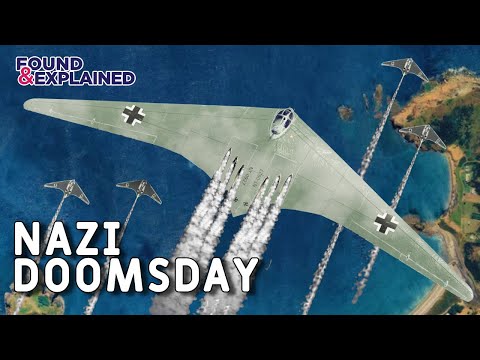
Near the end of World War II, German engineers proposed an aircraft concept unlike anything flying at the time. It was designed to cross the Atlantic, outrun Allied interceptors, and evade early radar systems. The aircraft was never built, but its design represented one of the most advanced bomber concepts of the war. Known as the Horten Ho 18, it was intended to form the core of Germany’s long range “Amerika Bomber” program.

The goal was direct. German leadership wanted a bomber capable of striking targets on the US East Coast, including industrial centers and aircraft factories. The strategy focused on forcing the United States to divert resources to homeland defense while disrupting American aircraft production.
The Amerika Bomber Program
By 1942, the Reich Air Ministry formalized requirements for a bomber with a range of approximately 11,000 kilometers and a bomb load of 4,000 kilograms. Several major German manufacturers submitted designs, including the Me 264 and Ju 390. None met the full operational requirements. Range, payload, and production complexity proved limiting. Some proposals depended on using the Azores as a forward base, which was politically and militarily unrealistic.

As these conventional designs stalled, an unconventional team entered the picture. The Horten brothers, known for their radical flying wing aircraft, believed their approach could solve the range and efficiency problem.
The Horten Flying Wing Solution
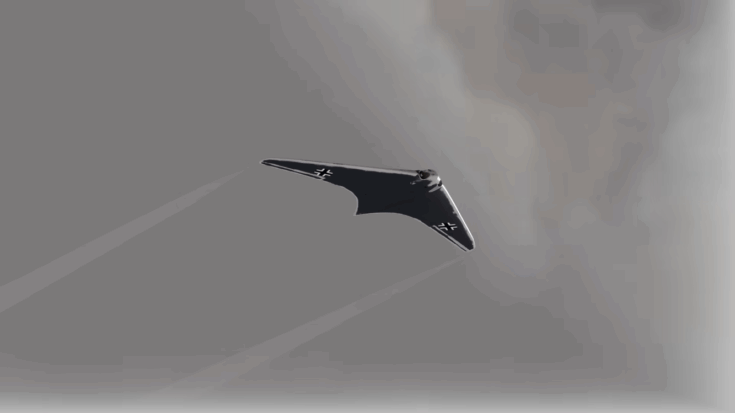
In late 1944, the Horten brothers developed a flying wing bomber concept that became the Ho 18. The design eliminated a traditional fuselage and tail, using the entire wing to generate lift. This configuration improved aerodynamic efficiency and reduced drag. It also lowered the aircraft’s radar signature due to its smaller frontal cross section and blended shape.

The proposed Ho 18 would have a wingspan of about 40 meters and a crew of four. It was designed to use six Jumo 004 turbojet engines embedded within the wing. Estimated cruise speed was around 750 kilometers per hour, with a maximum near 900 kilometers per hour. At those speeds, interception by Allied fighters would have been extremely difficult.
Construction was planned using wood and carbon based adhesives, which further reduced radar reflectivity and conserved strategic metals. The aircraft was also designed with a jettisonable tricycle landing gear and rocket assisted takeoff to reduce weight after departure.
Design Compromises and Cancellation
In early 1945, the Ho 18 was approved for development in partnership with Junkers. The original design was soon altered by engineering committees. Vertical tail surfaces were added, engines were moved into external nacelles, and key efficiency advantages were lost. These changes increased drag and reduced the aircraft’s effective range.

The revised versions no longer reflected the Horten brothers’ original concept. Production was planned for late 1945, but worsening Allied bombing, material shortages, and Germany’s collapsing war situation ended the program before construction began.
Influence on Postwar Aviation
Although the Ho 18 never flew, its flying wing design was far ahead of its time. Modern analysis shows that its aerodynamic efficiency and reduced radar profile were genuine advantages. After the war, flying wing concepts reappeared in advanced American aircraft, most notably the B-2 Spirit stealth bomber.

The Ho 18 remains one of the most advanced bomber concepts of World War II. It illustrates how far German designers were pushing aerodynamics and propulsion late in the war, even as the strategic situation made such projects impossible to complete.