

When Two B-17s Collided and Flew Home as One
YouTube / Yarnhub
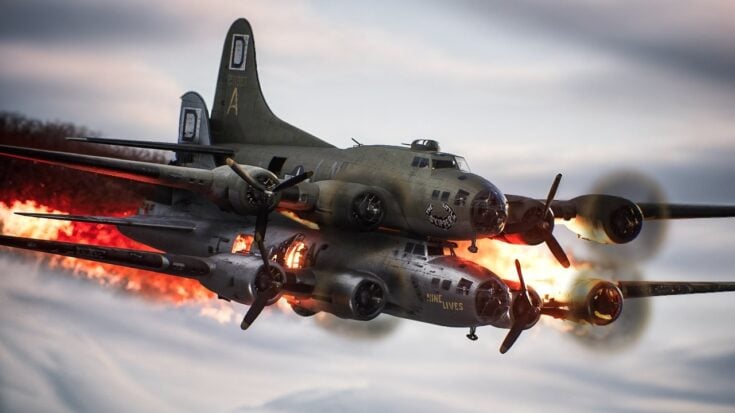
On December 31, 1944, 2nd Lieutenant Glenn Rojohn was piloting “The Little Skipper” over the North Sea when another B-17 crashed into him from below and locked itself to his aircraft. Neither plane could break free. Both were still flying.
The Mission
The 451st Bomb Group was targeting oil refineries in Hamburg when flak tore apart the formation on the bomb run. Two B-17s collided directly ahead of Rojohn, and six men parachuted from the wreckage. His bombardier dropped their payload on target and the formation turned for home. Then fifty German fighters arrived.

Me 262s screamed through the formation too fast to engage. Bf 109s and Fw 190s followed. A B-17 called “Faithful Forever” took additional hits and went down, its entire crew bailing safely. P-51 escorts arrived briefly and drove the Germans off before departing to cover other aircraft further along the route. Rojohn flew on alone with what remained of his formation.
The Collision
Over the North Sea, a second fighter attack hit the lead aircraft, “Nine Lives,” killing both pilots instantly. The aircraft continued flying with dead men at the controls, climbing slowly on a slight upward trajectory. Rojohn moved to fill the lead position and couldn’t locate the “Nine Lives” until it was too late.
At 12:44, the “Nine Lives” pierced the aluminum belly of “The Little Skipper” from below and locked into place. Eight engines. Two crews. One aircraft no one was designed to fly.

Ball turret gunner Corporal Joe Russo on “The Little Skipper” was now trapped. The “Nine Lives” fuselage had clamped around his turret completely. Three crewmen worked to free him and couldn’t move it. Through the plexiglass they could see Russo crossing himself. Over the intercom, his crew could hear him reciting the Hail Mary. Co-pilot Bill Leek removed his helmet and disconnected from the intercom to give Russo privacy for what was coming.
Getting Home
With one engine on the “Nine Lives” already burning and fire spreading across the left wing, Rojohn knew that coming down over the North Sea meant certain death. He had to reach land. With both pilots bracing their feet against the instrument panel for leverage, Rojohn and Leek coaxed the locked aircraft through a slow turn. The German coast came back into view. Ammunition cooked off in the flames and .50 caliber rounds sprayed in every direction as they crossed the coastline.

Rojohn ordered his crew to bail from the tail door, directly through the flames. Three crewmen made one final attempt to free Russo before jumping. They couldn’t. Rojohn ordered Leek to jump. Leek refused, knowing Rojohn couldn’t control both aircraft alone.

The two planes hit the island of Wangerooge. The “Nine Lives” exploded on impact and launched “The Little Skipper” upward. The Skipper belly-flopped back to earth, the left wing sheared through a wooden building, and the fuselage split apart. When it stopped, both pilots were alive with cuts and bruises.
Six men survived from “The Little Skipper.” Four survived from the “Nine Lives.” Rojohn received the Distinguished Flying Cross and spent the rest of his life crediting Leek for his survival. Russo did not make it out.







