Why German Fighters Attacked B-17 Formations Head-On
YouTube / WWII US Bombers
In 1944, American bomber formations flying over Europe depended on tight formation flying for survival. The B-17 carried heavy defensive armament, but its real strength came from overlapping fields of fire. Each aircraft protected the others, creating a moving wall of machine guns.
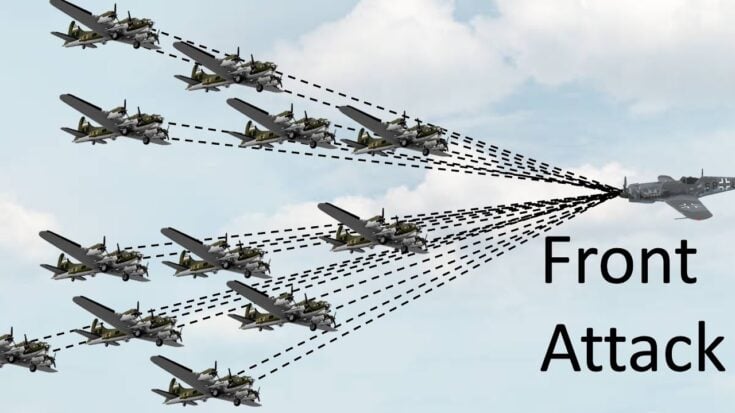
German fighter pilots developed tactics designed to break that advantage. The most common approach was the head-on attack. At first glance, this placed the fighter directly in front of concentrated defensive fire. In practice, it exploited speed, timing, and the limits of human reaction.

The Limits of Defensive Fire
Bomber gunners were tasked with protecting themselves, supporting the formation, and destroying interceptors. During the first half of 1944, Eighth Air Force gunners were credited with thousands of victories. Adjusted for overclaiming, the data shows that roughly 21,600 rounds were required to destroy a single fighter.

This number highlights a key limitation. Even with multiple guns firing, bringing down a fast-moving target was difficult. Combat occurred in three dimensions, often within seconds, and required precise tracking and deflection shooting under extreme pressure.
Head-On Attacks and Closing Speed
The Focke-Wulf Fw 190 was a primary interceptor used against bomber formations. At altitude, it could approach at speeds far higher than the bombers themselves. When attacking head-on, the combined closing speed exceeded 600 mph.
This gave bomber gunners only about three seconds to engage. In that brief window, a squadron might fire around 1,200 rounds. Compared to the 21,600 rounds typically needed to destroy a fighter, the probability of a kill during a single head-on pass remained low.

German pilots took advantage of this. They opened fire at medium range, closed rapidly, and broke away before defensive fire could become effective. After several passes, they would withdraw due to ammunition limits.
Why Tail Attacks Were Less Common
Attacks from the rear told a different story. In a tail approach, the closing speed dropped significantly, giving gunners more time to track and fire. Engagements could last over seven seconds, allowing far more rounds to be directed at the attacker.

This increased exposure made rear attacks more dangerous for intercepting fighters. The longer firing window improved accuracy and raised the likelihood of being hit. As a result, tail attacks were less frequent despite appearing tactically simpler.
A Tactical Balance in the Air War
The pattern of attacks reflected these realities. German pilots favored head-on approaches because they minimized exposure to defensive fire. Bomber formations, in turn, relied on mutual support and volume of fire to survive repeated engagements.

This exchange shaped the air war over Europe. The B-17’s defensive system worked as designed, but it depended on coordination and numbers rather than individual lethality. German interceptors adapted by exploiting speed and timing, turning each attack into a brief and calculated risk.