Why Does the B-52 Produce So Much Black Smoke?
YouTube / Defense Digest
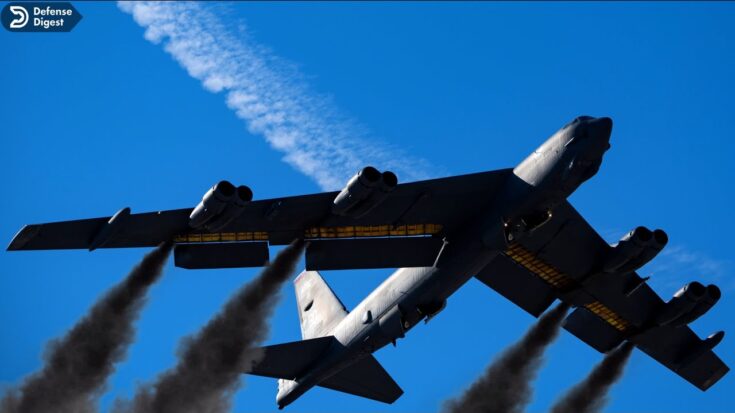
Few sights in military aviation are as recognizable as a B-52 Stratofortress rolling down the runway with thick black smoke pouring from its engines. For an aircraft still flying combat missions in 2026, that smoke looks like something from a different era. The explanation connects directly to the engines powering it, the fuel burning through them, and a modernization debate that has run for decades without resolution.

The Engine Behind the Smoke
The B-52 runs on eight Pratt and Whitney J57 turbojet engines, a design rooted in 1950s technology. Turbojet engines work by compressing incoming air, mixing it with fuel, igniting the mixture, and expelling the exhaust through a nozzle to generate thrust. The design is mechanically simple and reliable but inefficient, particularly at the low speeds and altitudes where the B-52 spends most of its operating time.

That inefficiency produces incomplete combustion. Unburned hydrocarbons exit the engine as exhaust and become visible as black smoke when they contact outside air. The effect is most dramatic during takeoff, when the engines are running at maximum thrust and burning the most fuel. The more fuel burned under those conditions, the more smoke produced.

The fuel itself contributes to the problem. The B-52 burns JP-8, a high-energy kerosene-based military jet fuel that produces more exhaust particulates than the Jet-A and Jet-A1 fuels used in commercial aviation. JP-8’s energy density drives the volume of exhaust gas released during combustion, compounding what the engines were already producing on their own.
Why It Was Never Fixed
Modern turbofan engines solve both problems. A turbofan routes additional air around the engine core, improving efficiency, reducing fuel consumption, and producing significantly cleaner exhaust. Better combustion chambers and fuel injectors burn fuel more completely, cutting smoke output further. Nearly every modern military and commercial jet uses some variation of this design.

The B-52 does not, and repeated proposals to change that have stalled for the same reason: cost. Re-engining hundreds of aircraft with eight engines each requires not just new powerplants but modifications to the airframe, fuel systems, and supporting infrastructure. The Air Force has consistently argued that the investment doesn’t justify the return, particularly for an aircraft projected to retire in the 2040s.

That calculus may finally be changing. Rolls-Royce has been testing the F130 turbofan engine for the B-52 fleet at NASA’s Stennis Space Center as part of an active modernization program. If the re-engining effort proceeds, the aircraft that has trailed black smoke across runways for seven decades would gain engines producing cleaner exhaust, lower fuel consumption, and extended range. The B-52 that entered service in the 1950s could potentially carry turbofan technology into its second century of operation.