CENTCOM Reveals Apache Helicopters Operating Over Hormuz as Iran Reimposes Limits
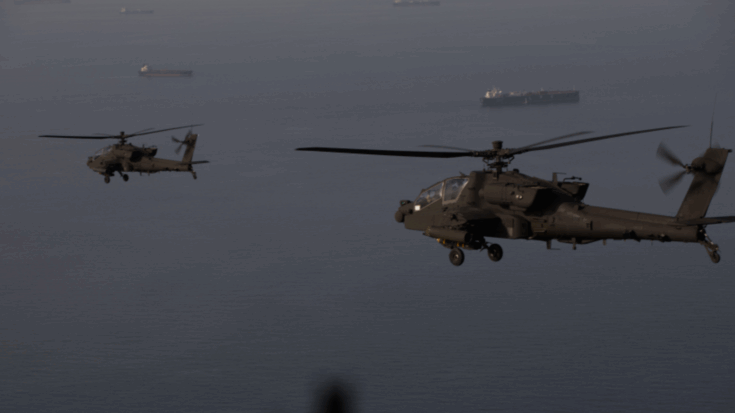
@CENTCOM / X
In April 2026, events in the Strait of Hormuz once again drew attention to one of the world’s most sensitive maritime routes. This narrow passage, linking the Persian Gulf to the open ocean, has long been vital for global energy transport. Any disruption in its waters can affect trade far beyond the region, making even small incidents a matter of international concern.
Reports from maritime authorities described a tense situation developing near the coast of Oman. A commercial tanker traveling through the area was approached by armed boats linked to Iran’s Revolutionary Guards. According to the ship’s captain, the vessels opened fire without issuing a prior radio warning. Although the crew remained unharmed, the encounter raised alarm among shipping operators and governments monitoring the region.
A Disputed Waterway Under Pressure
The incident did not occur in isolation. It followed renewed restrictions placed on shipping through the strait by Iranian authorities. These measures came after the United States reaffirmed its blockade policy targeting vessels connected to Iranian ports. As a result, several ships reportedly turned back rather than risk confrontation, highlighting the uncertainty facing civilian crews navigating the route.
Public statements from Iranian military channels suggested that these actions were tied to broader political tensions. Officials indicated that restrictions would remain in place as long as Iranian shipping faced obstacles elsewhere. This back-and-forth messaging created confusion, with announcements of reopening quickly followed by renewed controls, leaving the status of the strait unclear.
Such instability has historical roots. The Strait of Hormuz has been a focal point of disputes for decades, particularly during periods of strained relations between Iran and Western powers. Its narrow width and heavy traffic make it both strategically important and difficult to manage during crises.
Military Presence and Surveillance Efforts
Amid these developments, the United States increased its visible presence in the area. Images released by U.S. Central Command showed AH-64 Apache helicopters operating over the waterway. These aircraft were tasked with monitoring activity and responding to potential threats, including fast-moving boats and unmanned aerial systems.
Earlier in March, during a Pentagon briefing, Dan Caine explained that additional air assets had been deployed to support operations in the region. Among them were A-10 Thunderbolt II aircraft, known for their ability to engage ground and surface targets. Their role included countering small, fast vessels that could pose risks to larger ships.
The AH-64 Apache, however, plays a distinct role in such environments. Designed for flexibility, it combines advanced sensors with a range of weapons suited for different targets. Its onboard systems allow crews to detect and track objects in crowded conditions, where distinguishing between civilian and hostile activity can be challenging.
Capabilities Suited to Modern Threats
The Apache’s effectiveness comes from its ability to respond quickly to changing situations. Equipped with a 30 mm chain gun and guided rockets, it can engage small boats at close range while minimizing unintended damage. It can also carry more powerful missiles when needed, offering a range of options depending on the threat.
Its sensor suite includes thermal imaging and radar systems that help identify targets even in poor visibility. In a region like the Strait of Hormuz, where traffic is dense and threats can appear suddenly, this capability is especially valuable. Crews can build a clear picture of their surroundings and share that information with other units in real time.
As tensions continue, the presence of such aircraft reflects the importance placed on keeping the strait open and secure, even as political disputes shape the risks faced by those traveling through it.