CENTCOM Reveals SEAD Operations Over Iran as EA-18G Growler Appears With Unusual Missile Loadout
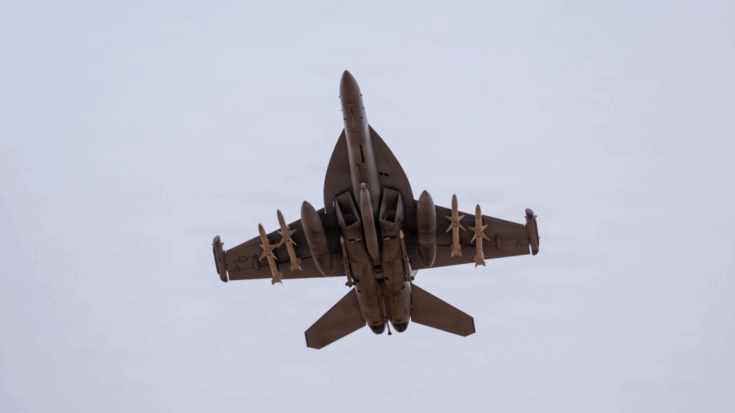
A U.S. Navy EA-18G Growler launches for an Operation Epic Fury mission on March 14, 2026. (Photo: U.S. Air Force)
Modern air campaigns often depend on aircraft designed not only to strike targets but also to clear the skies of threats before other missions begin. Newly released images from U.S. Central Command show that Suppression of Enemy Air Defenses, commonly known as SEAD, remains a major focus during Operation Epic Fury. The photographs reveal several aircraft launching for missions connected to operations over Iran, offering a closer look at how airpower is being applied weeks after the opening strikes.
The images stand out because they display equipment rarely seen together in operational settings. Aircraft normally configured for specialized electronic warfare appear equipped for broader combat roles, suggesting that planners are adapting to conditions that continue to change as operations move deeper inland.
Growler Loadout Signals Ongoing Electronic Warfare Effort
Among the aircraft shown, the EA-18G Growler draws the most attention. The Growler is the U.S. Navy’s primary electronic attack aircraft, built to disrupt radar systems and neutralize air defenses through jamming and missile strikes. In the released photos, one Growler carries an uncommon loadout featuring four AGM-88 anti-radiation missiles alongside the AN/ALQ-99 Tactical Jamming System, two AIM-120 AMRAAM air-to-air missiles, and two external fuel tanks.
The missile configuration itself is notable because it combines two AGM-88C High-speed Anti-Radiation Missiles with two newer AGM-88E Advanced Anti-Radiation Guided Missiles. The newer version improves targeting accuracy by tracking radar emissions even after systems shut down, allowing pilots to engage mobile or briefly active defenses. Observers identified the newer missiles by their green fin markings and distinct nose coloring. A similar arrangement appeared during U.S. strikes against Houthi targets in Yemen in 2025, though Growlers more commonly carry only two AGM-88 missiles alongside multiple jamming pods.
F-16 Wild Weasels Expand Their Role
The photos also highlight F-16CM Fighting Falcons assigned to the long-standing “Wild Weasel” mission, a role focused on hunting surface-to-air missile systems. These aircraft now appear with mixed weapon loads, combining an AGM-88C HARM missile with a GBU-31(V)3 Joint Direct Attack Munition, a 2,000-pound guided bomb designed to penetrate hardened targets. Earlier in the operation, F-16s were seen carrying anti-radiation missiles alone, indicating that their mission profile has expanded.
Supporting equipment attached to the aircraft adds further detail. The jets carry an AN/ASQ-213 HARM Targeting System pod to detect hostile radar signals and a Litening targeting pod for precision strikes. A newer electronic warfare system known as the Angry Kitten pod is also present. Originally developed for training exercises, the system has evolved into a digital radio frequency memory jammer capable of confusing enemy sensors. Its appearance marks one of its first known operational uses. The aircraft’s defensive weapons include three AIM-120 missiles and one AIM-9X Sidewinder for close-range protection.
Stealth and Carrier Aviation Join the Mission
An F-35A Lightning II also appears in the released imagery. While the aircraft’s exact task is unclear, the stealth fighter is capable of conducting SEAD missions using internal sensors rather than externally mounted equipment. Its ability to detect radar emissions without revealing its position allows it to support other aircraft operating nearby.
Separate imagery from earlier in the week shows another EA-18G launching from the aircraft carrier USS Abraham Lincoln. That aircraft carried both the older AN/ALQ-99 jamming system and the newer AN/ALQ-249 Next-Generation Jammer Mid-Band pod, along with additional fuel tanks and air-to-air missiles. The combination highlights an ongoing transition toward newer electronic warfare systems while older equipment remains in service.
Why Air Defense Suppression Continues
Operation Epic Fury entered its third week after initial strikes began on February 28, 2026. Despite statements suggesting air superiority had been achieved, continued SEAD missions indicate remaining risks. Military officials have described the situation as “localized air superiority,” meaning some areas are secure while others still contain active threats.
Recent released footage shows surface-to-air missile launchers and anti-aircraft guns being destroyed, including MIM-23 Hawk systems and ZU-23-2 autocannons. These targets demonstrate that defensive networks remain active, especially farther inland where aircraft encounter more complex coverage. Long-range bombers such as the B-52H Stratofortress continue using AGM-158 Joint Air-to-Surface Standoff Missiles, allowing strikes from outside defended zones.
Iran’s air defense structure has historically combined older Soviet-era equipment with domestically developed systems emphasizing mobility and electronic warfare resistance. Such networks are difficult to eliminate quickly because launchers can relocate and radar units may operate briefly before shutting down. For this reason, SEAD aircraft remain essential even after early phases of a campaign claim success in reducing defenses.
The released images offer a rare operational snapshot, showing how modern air forces blend electronic attack, stealth technology, and precision weapons to maintain control of contested airspace while operations continue to evolve.