F/A-18E That Downed Syrian Su-22 in 2017 Spotted Launching From USS Gerald R. Ford During Operation Epic Fury
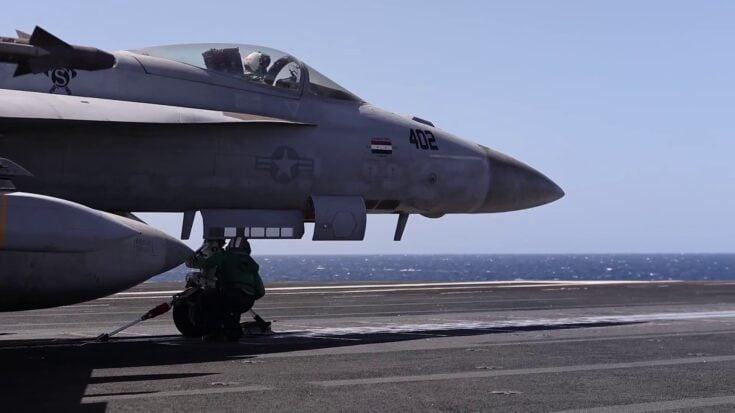
Screenshot from official CENTCOM footage
Modern military aircraft often carry long histories that stretch across different conflicts and oceans. One such aircraft, an F/A-18E Super Hornet bearing bureau number 168912, has once again appeared in operational footage nearly a decade after taking part in a rare air-to-air engagement. The jet, recognized for its role in a 2017 combat incident over Syria, was recently filmed launching from the aircraft carrier USS Gerald R. Ford while supporting ongoing operations in the Red Sea.
The sighting connects two separate periods of military activity: the coalition air campaign against extremist groups in Syria and the current maritime deployments tied to Operation Epic Fury. For aviation observers and historians, the aircraft represents continuity in naval aviation, showing how individual airframes can move from one historic moment to another while remaining in active service.
A Historic Air Combat in 2017
On June 18, 2017, the Super Hornet launched from USS George H. W. Bush responded to a developing situation near the Syrian town of Ja’Din. Coalition officials reported that a Syrian Su-22 fighter-bomber dropped munitions close to positions held by Syrian Democratic Forces fighters. Under established rules of engagement, coalition aircraft intervened to defend partner forces operating against extremist militants in the region.
At approximately 6:43 p.m. local time, the F/A-18E fired an AIM-120 AMRAAM missile, successfully destroying the Su-22. The engagement marked the first time since 1999 that the United States shot down a crewed aircraft in air combat and the first such victory for the Super Hornet variant. The Syrian pilot ejected safely and was later recovered by friendly forces.
From Combat Record to Carrier Deployment
Following the incident, the aircraft continued regular fleet service and remained assigned to Strike Fighter Squadron 87, part of Carrier Air Wing 8. Over time, a kill marking appeared on the jet’s fuselage, quietly recording its role in the 2017 event. Such markings are rare in modern naval aviation and reflect moments that stand out within long operational careers.
Recent footage released through U.S. Central Command shows the same aircraft positioned on one of USS Gerald R. Ford’s forward catapults. The carrier is currently operating in the Red Sea after a rapid redeployment across the Atlantic and through the Suez Canal. Its mission includes supporting Operation Epic Fury and reinforcing regional defense as tensions increased across nearby waterways.
Operation Epic Fury and the Ford’s Role
Operation Epic Fury places carrier aviation at the center of regional air operations. The USS Gerald R. Ford, the Navy’s newest carrier class, has launched strike, surveillance, and defensive patrol missions using advanced launch systems designed to increase sortie rates and flexibility during sustained operations.
Unlike carriers focused primarily on ground strikes, imagery from the Ford shows many aircraft equipped with air-to-air weapons such as AIM-9X Sidewinders and AIM-120 missiles. This configuration suggests a strong emphasis on combat air patrols intended to intercept drones and missiles threatening allied bases and shipping routes. The carrier operates alongside other naval forces positioned across the region to create layered air defense coverage.
Recent Operations and Extended Service
Before entering the current theater, aircraft 168912 also participated in deployments linked to operations in the Caribbean during late 2025 and early 2026. Aviation photographers documented the jet conducting flight operations from Puerto Rico, demonstrating how carrier aircraft frequently shift between missions ranging from regional security patrols to high-intensity combat readiness.
The USS Gerald R. Ford itself has faced an unusually long deployment cycle. Since departing the United States in mid-2025, the ship has crossed multiple operational zones and supported several missions before joining Operation Epic Fury. A non-combat fire aboard the carrier’s laundry area recently caused minor injuries but was quickly contained, allowing the ship to remain operational during ongoing missions.
Continuity in Modern Naval Aviation
As operations continue, aircraft like the Super Hornet that achieved the 2017 air-to-air victory remain part of daily flight schedules. Their presence highlights how modern naval aviation blends past combat experience with present-day deterrence duties. Kill markings, once common in earlier eras of air warfare, now appear rarely, making this aircraft a visible link between historical events and current military activity.
The aircraft’s reappearance during Operation Epic Fury illustrates how a single jet can move through changing strategic environments while maintaining its operational role. From defending partner forces over Syria to launching again from one of the world’s newest carriers, the Super Hornet continues to operate as part of evolving air operations shaped by shifting global tensions.