Battle-Damaged KC-135 Arrives in Britain With Shrapnel Patches Across Its Fuselage
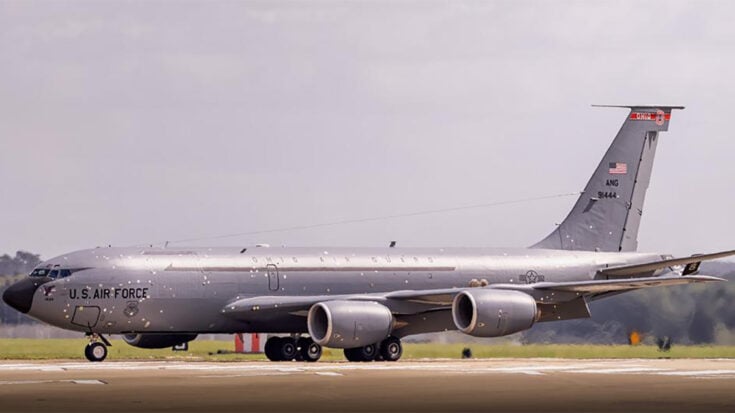
CREDITS: @marklynham on Instagram
KC-135R Stratotanker 59-1444 landed at RAF Mildenhall on April 12 under the callsign REACH 717, and spotters at the fence line immediately noted something unusual. Small unpainted patches covered sections of the airframe, the visible signature of field battle damage repairs applied to an aircraft that had been sitting at Prince Sultan Air Base in Saudi Arabia when Iran struck it.
KC-135 58-0011 being flown from the boneyard over to Tinker AFB to be restored into service. Explains why the landing gear was down for most of the flight. pic.twitter.com/IcRYCnsPpX
— CorreaPhotography (@CorreaPhtgphy) April 3, 2026
What the Patches Show
Battle damage repairs use available materials to restore structural integrity quickly enough for the aircraft to fly again. They are not cosmetic. The spread of small patches across the KC-135’s airframe is consistent with shrapnel damage from nearby explosions rather than a direct hit, which typically produces more concentrated and catastrophic damage. The aircraft flew from Saudi Arabia to Britain bearing those repairs, suggesting it was assessed as airworthy enough to transit but not in condition for continued combat operations.
View this post on Instagram
Flight tracking data indicates 59-1444 deployed from the United States to Prince Sultan in early March. The base was struck by Iranian attacks multiple times afterward. The mid-March attack reportedly damaged five KC-135s. A subsequent strike on March 27 destroyed E-3 Sentry 81-0005 and may have also damaged EC-130H Compass Call and KC-46 Pegasus aircraft according to unverified reports. Which specific attack caught 59-1444 has not been officially confirmed.
The Emergency Stop in Crete
The transit to Mildenhall was not straightforward. On April 10 the aircraft was flying northwest over the Mediterranean approaching Greece when it switched its transponder to squawk 7700, the universal emergency code, and turned immediately toward Chania International Airport near Naval Support Activity Souda Bay. The exact cause of the emergency has not been confirmed.
Given the visible battle damage repairs on the airframe, a cabin pressurization issue is a plausible explanation. Pressurization faults typically produce a rapid descent to approximately 10,000 feet where unpressurized flight is safe. The aircraft may have required additional field repairs at Chania before it could continue to the United Kingdom. It arrived at Mildenhall two days later.
I will remind folks that the WSJ reported that 5 tankers were damaged in a missile strike March 13th “in recent days”. Given that other Prince Sultan AB tankers had been seen since that report, my theory is that 59-1444 #AE0361 was one of those five tankers hit before 3/13. pic.twitter.com/ThsH5ReO6T
— Evergreen Intel (@vcdgf555) April 12, 2026
What Happens Next
Once 59-1444 returns to the United States it will undergo formal damage assessment, followed by a full overhaul if the repairs are determined to be feasible and economically justifiable. The answer to that question may not be straightforward. In the weeks following the Prince Sultan attacks the Air Force began mobilizing stored KC-135s from the boneyard at Davis-Monthan Air Force Base for restoration at Tinker AFB. That mobilization suggests some of the damaged tankers are not expected to return to service quickly, if at all. Pulling aircraft out of long-term storage to compensate for combat losses is not a routine logistics decision.
The KC-135 fleet was already under pressure before Operation Epic Fury began. Multiple airframes have now been damaged or destroyed in the campaign. The patches visible on 59-1444 crossing the English coast are a direct record of what Iranian fire did to the tanker fleet supporting the air war over Iran.