

How America Dismantled Iran’s Navy in Days
YouTube / LiveNOW from FOX
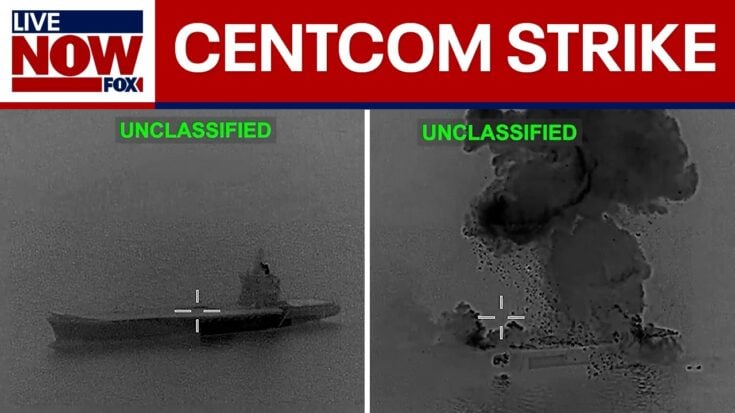
Five days into Operation Epic Fury, US Central Command Commander Admiral Brad Cooper stood at a podium at MacDill Air Force Base in Tampa and delivered a blunt assessment. Iran’s navy had been decimated. Its drone capabilities had been significantly damaged. And in the hours before the briefing, American forces had sunk an Iranian drone carrier roughly the size of a World War II aircraft carrier. It was still burning when Cooper spoke.
The Naval Picture
The drone carrier strike brought the total number of Iranian vessels sunk or destroyed to over 30. The ship, which CENTCOM posted footage of on X, represented one of Iran’s more significant asymmetric naval assets, a platform designed to project unmanned systems across the Gulf without exposing conventional warships. Its destruction removed a capability Iran had been developing specifically to threaten the American carrier groups now operating in the region.

Cooper was direct about the trajectory. US combat power has continued to increase throughout the operation while Iran’s has declined. Iranian ballistic missile attacks have dropped by 90 percent since the first day of the campaign. Drone attacks have fallen by 83 percent. The numbers reflect a force being systematically degraded faster than it can reconstitute.
Hitting What They Have and What Comes Next
In the 72 hours before the briefing, American bombers struck nearly 200 targets deep inside Iran including sites around Tehran. B-2 bombers dropped dozens of 2,000-pound penetrating bombs on buried ballistic missile launchers in the hours immediately preceding Cooper’s remarks. The US also struck what Cooper described as Iran’s equivalent of Space Command, targeting the command and control infrastructure that links Iran’s surveillance and communications architecture.

President Trump tasked CENTCOM specifically with dismantling Iran’s ballistic missile industrial base, not just its existing inventory. Cooper made the distinction explicit. The campaign is not simply destroying missiles already built. It is targeting the production lines, facilities, and infrastructure Iran would need to rebuild that capability after the conflict ends.
What’s Coming
Defense Secretary Pete Hegseth used the briefing to signal that the campaign’s intensity was about to increase. More fighter squadrons, additional defensive capabilities, and more frequent bomber pulses were all described as imminent. More than 100 additional fighter jets including F-35s, F-22s, F-15s, and F-16s had already been tracked departing bases in the US and Europe toward the Middle East by open-source aviation analysts in the days surrounding the briefing.







