Operation Epic Fury: What We Know About the US and Israeli Strike on Iran
YouTube / Sandboxx
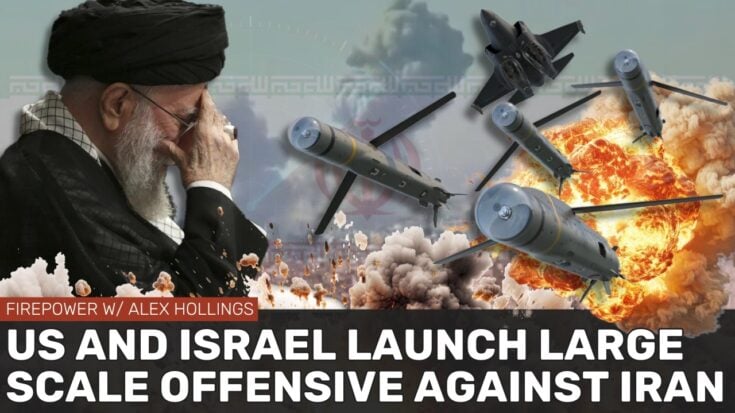
In the early hours of a Friday morning, the United States and Israel launched large-scale combat operations against the Iranian regime. Strikes began at approximately 1:15 a.m. Eastern time, targeting senior Iranian officials, Revolutionary Guard command infrastructure, air defense networks, missile and drone launch sites, and military airfields across the country. Multiple sources are reporting that Supreme Leader Ayatollah Ali Khamenei was among those killed, though the fog of war makes confirmation difficult.
How the Attack Unfolded
The opening wave came in the form of ship-launched BGM-109 Tomahawk cruise missiles alongside undisclosed air-launched weapons deployed by both US Air Force and carrier-based Navy strike fighters. Centcom imagery released the same day showed at least one black-painted Tomahawk in flight, a first. The dark coating likely indicates radar-absorbent material, suggesting these particular missiles were specifically configured to penetrate whatever remained of Iran’s integrated air defense network after last June’s strikes.

The timing is significant. Most large-scale attacks begin at night for concealment and to reduce civilian casualties. This one started at daybreak on a Friday, the start of a workday. That detail points strongly toward decapitation strikes, operations designed around confirmed intelligence about where senior leaders would be at a specific moment.
The Force Behind the Strike
The military assets assembled for this operation represent the largest concentration of American combat power in the Middle East since the 2003 invasion of Iraq. The USS Gerald R. Ford carrier strike group arrived just days before the attack to join the USS Abraham Lincoln already on station. Together they bring nearly 100 strike aircraft to the theater. The Ford’s air wing includes four squadrons of F/A-18 Super Hornets and a squadron of EA-18G Growler electronic warfare aircraft. The Lincoln, though older, carries fifth-generation F-35Cs operated by Marine Fighter Attack Squadron 314, the Black Knights.

Supporting them are more than 120 Air Force F-35As, F-22 Raptors, F-15E Strike Eagles, and F-16s, along with over 100 aerial refueling tankers and 200 logistics aircraft. Roughly one-third of the Navy’s deployable surface fleet is now operating in the region, including at least eight Arleigh Burke-class guided missile destroyers. Approximately 30,000 US troops are positioned at bases throughout the Middle East, and Task Force Scorpion reportedly deployed Locus one-way attack drones in combat for the first time.
What the US Is Trying to Accomplish
President Trump announced the operation under the name Operation Epic Fury, citing nearly five decades of Iranian aggression and the regime’s continued pursuit of nuclear weapons. Stated objectives include destroying Iran’s missile industry, dismantling its navy, severing support to proxy forces, and permanently ending Iran’s nuclear program. Achieving all of those goals, however, would require a far larger operation and almost certainly ground forces, which the administration has not committed to deploying.

The more immediate aim may be regime change through air power alone, creating enough internal pressure to accelerate the popular uprising already underway inside Iran. That uprising has cost an estimated 30,000 Iranian lives as the government cracked down on protesters in the months prior. Whether an organized opposition exists that could fill a post-regime power vacuum remains an open and serious question.
Iran’s Response and What Comes Next
Iran has already launched waves of ballistic missiles and drone strikes at American and Israeli positions across the region. Many have been intercepted, but footage from the ground suggests some are getting through. No American casualties have been reported as of this writing.

As night falls over Iran, strikes are expected to intensify. The pattern of the campaign, opening blows followed by pressure and pauses, suggests the US may be building in diplomatic off-ramps designed to force Iranian capitulation without a full ground invasion. Whether Tehran has the capacity or the leadership left to accept one remains to be seen.