Why America Needed TWO Aircraft Carriers to Strike Iran
YouTube / AiTelly
When the Gerald R. Ford departed the Atlantic Theater, it wasn’t a routine rotation. It was a convergence. The Ford and her Strike Group 12 faced a three-week sprint through the Strait of Gibraltar, the Suez Canal, and the Red Sea to link up with the USS Abraham Lincoln already on station in the Middle East. When the two carriers met, they formed a dual carrier strike force – a concentration of firepower rarely assembled outside of a world war.
The Problem a Single Carrier Can’t Solve
In modern naval warfare, exhaustion kills as effectively as any missile. A single carrier crew cannot sustain continuous combat operations indefinitely. Pilots need rest. Aircraft need maintenance. Catapults need servicing. The solution isn’t working harder. It’s working in shifts.

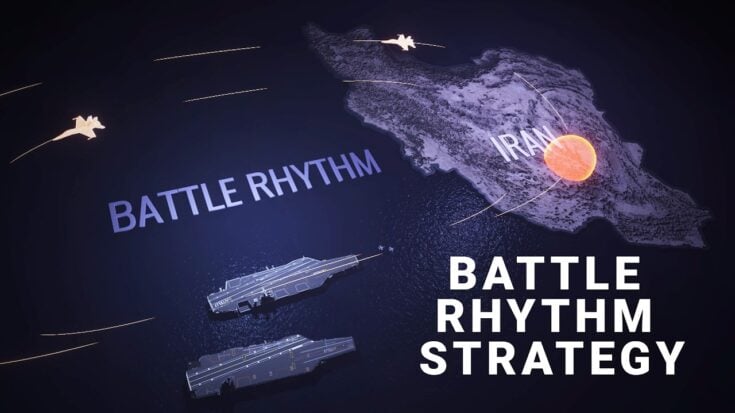
The Lincoln and the Ford divide the clock. From midnight to noon, the Lincoln owns the darkness. Her experienced airwing and battle-tested steam catapults hammer targets under the cover of night. As the sun rises and the Lincoln enters reset, the Ford picks up the fight. From noon to midnight, her Electromagnetic Launch System generates a higher sortie tempo, pushing strike fighters into the air when visual identification of targets is clearest. The enemy gets no safe hour. There is no pause, no gap, no silence.

Battle Rhythm and the Continuous Strike Doctrine
This rotation is not improvised. It follows a doctrine called battle rhythm, the structured daily heartbeat of a carrier strike group. Two pulses drive it. The operational pulse governs flight operations, running continuous launch and recovery cycles every 60 to 90 minutes. The command pulse synchronizes admirals and sailors through fixed schedules of intelligence briefs, targeting boards, and mission orders. Together, they convert 24 hours of potential chaos into a sustainable routine of war.
Two carriers working this system produce something a single carrier physically cannot: continuous strike coverage around the clock. With nearly 100 dedicated strike aircraft between them, the combined air wing can saturate an adversary’s air defense network from multiple vectors simultaneously. That volume of attack is called an alpha strike, and it is designed to overwhelm rather than pressure.

The Hardware Behind the Strategy
The Ford class itself represents a generational leap in capability. The ship spans roughly 25 decks compared to the Nimitz class’s 18, carries up to 90 aircraft versus the Nimitz’s 60, and features a flight deck covering nearly five acres. Her advanced radar and combat systems can autonomously detect, prioritize, and engage multiple incoming drone threats with minimal manual input, a critical advantage in a threat environment built around swarming tactics.

What Two Carriers Can Actually Do
The dual carrier posture in the region was never just about presence. If diplomacy collapsed, the two ships represented the opening move of a multi-phase campaign. Cyber and space operations would blind Iranian command networks first. Stealth aircraft would then hunt and destroy surviving mobile air defense systems.
B-2 bombers carrying Massive Ordnance Penetrators would strike hardened underground nuclear facilities using a double-tap tactic designed to collapse reinforced structures from the inside. Finally, Tomahawk salvos from submarines would target command infrastructure and missile storage depots across the country.

Two carriers make that campaign possible at a pace the adversary cannot absorb or respond to. One carrier applies pressure. Two carriers remove the option to recover.