Why This Small Antenna Changes How the F-15E Fights
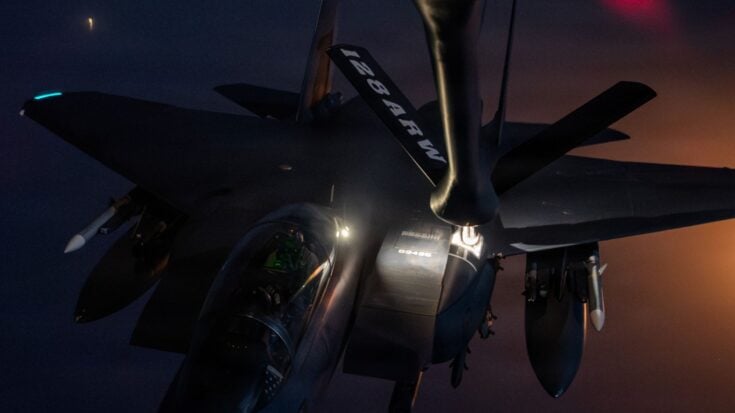
Photographs taken during Operation Epic Fury revealed a small but significant addition to the U.S. Air Force’s F-15E Strike Eagle. Mounted just behind the cockpit on the right side of the fuselage, a circular antenna array has appeared on several jets. At first glance, it looks minor. In practice, it reflects a deeper shift in how modern air combat is fought.
That circular antenna on this SJ F-15E looks like the CRPA tied to DIGAR (Digital GPS Anti-jam Receiver) which is an ongoing upgrade alongside RMP and MUOS/SATURN. I’ve seen it on a handful of F-15Es so far most of them LN tails but the deployed MO/SJs seem to have the mod. pic.twitter.com/Fagi52FlCk
— Abd (@blocksixtynine) April 9, 2026
The system is a Controlled Reception Pattern Antenna, part of the Digital GPS Anti-jam Receiver program introduced in 2022. Its purpose is straightforward: Keep navigation and targeting systems working even when the enemy is actively trying to disrupt them.
Fighting for the Signal
Modern warfare places increasing pressure on the electromagnetic spectrum. GPS signals, once taken for granted, are now routinely jammed or manipulated. This has been demonstrated repeatedly in recent conflicts, where both sides attempt to blind or mislead precision systems.
The CRPA addresses this directly. Instead of relying on a single antenna, it uses multiple elements to filter incoming signals. By focusing only on trusted sources and rejecting interference, it allows the aircraft to maintain accurate positioning even in contested environments.
This capability extends beyond U.S. GPS. The system can work across multiple satellite constellations, improving resilience when one network is degraded.