Navy Just Proved the Super Hornet Isn’t Going Anywhere
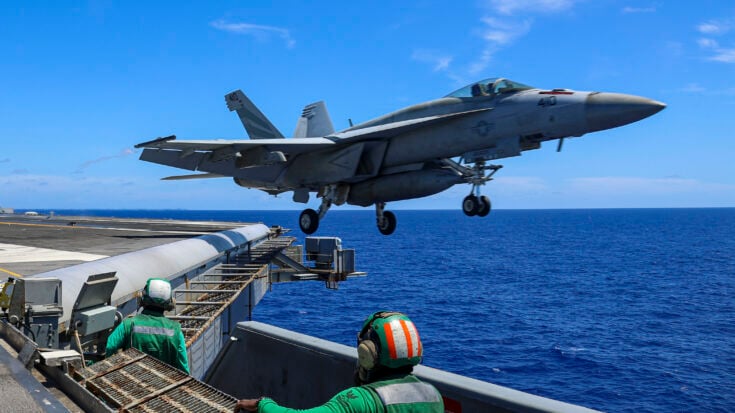
The U.S. Navy has quietly taken a major step toward keeping the F/A-18 Super Hornet relevant well into the 2040s. At Fleet Readiness Center Southwest, engineers recently completed the first fully in-house Block III upgrade of a Super Hornet, marking a shift away from relying entirely on Boeing for major modernization work.
That matters because Boeing plans to end new Super Hornet production by 2027. Once the production line closes, the Navy’s existing fleet of roughly 550 F/A-18E/Fs and EA-18G Growlers will carry the burden of carrier aviation until a future sixth-generation F/A-XX fighter arrives.
Extending the Life of the Carrier Fleet
The Block III upgrade is tied to the Navy’s broader Service Life Modification program. Earlier Super Hornets were originally built for 6,000 flight hours, but repeated upgrades pushed that figure to 7,500. The latest structural work now extends service life to 10,000 flight hours.
CVN-71 USS Theodore Roosevelt
ROKFLT, Busan
F/A-18E Buno.169953
VFA-25 “Fist of the Fleet” NH400Glad to meet the brand new Block III Super Hornet! pic.twitter.com/gKULgztBab
— Hornet (@hornetysfs) June 23, 2024
That buys the Navy time. Rather than replacing hundreds of aircraft at enormous cost, it can keep proven fighters flying while newer platforms remain years away.
The first upgraded jets returned to the fleet in 2024 ahead of schedule. Boeing later received a $931 million contract to continue work on 60 additional aircraft.
What Block III Actually Changes
The biggest transformation happens inside the cockpit.
Older displays are replaced with a 10×19-inch touchscreen known as the Advanced Cockpit System, giving pilots a much more modern interface. The jets also receive upgraded computing architecture, improved networking systems, infrared search-and-track capability, and reduced radar signature improvements.
Block III super hornet for context. There’s also nothing besides mirrors, necessary lights and the backup magnetic compass on the canopy frame, unlike the Su-57, which has some kind of selector on the canopy frame. You can see the different shapes, sizes and distinct positions of… pic.twitter.com/iQIkGbsXxm
— Heatloss (@heatloss1986) November 19, 2025
These upgrades do not turn the Super Hornet into a stealth fighter, but they dramatically improve how it operates in modern combat environments where networking and sensor fusion matter just as much as speed.
The Hard Part Happened Behind the Scenes
The upgrade process is far more complicated than installing new screens.
Technicians must strip large portions of the aircraft apart, remove aging wiring, replace fiber optics, modernize electrical systems, and inspect hidden structural damage. In many cases, corrosion and worn components are discovered only after the aircraft is disassembled.
Engineers worked through more than 350 pages of technical directives while coordinating with Boeing and Navy program offices.
VX-9 F/A-18E Block III Super Hornet headed out of Fort Worth Alliance Sunday. The most obvious external sign of a Block III seems to be the small hump on the top of the spine towards the tail. Maybe we’ll see them with the CFTs some day. 169971 XE-360 pic.twitter.com/NTNQdhmSq7
— Sam Combs (@pressxtolive) July 17, 2023
Why This Matters
The Navy still depends heavily on the Super Hornet. These aircraft recently flew combat missions during Operation Epic Fury and continue to serve as the backbone of carrier air wings.
The Block III upgrade ensures that backbone remains operational long after production ends. Instead of fading away, the Super Hornet is being rebuilt for a very different fight than the one it was originally designed for.