

Footage Shows Secretive ‘Flying Wing’ Making Emergency Landing in Greece
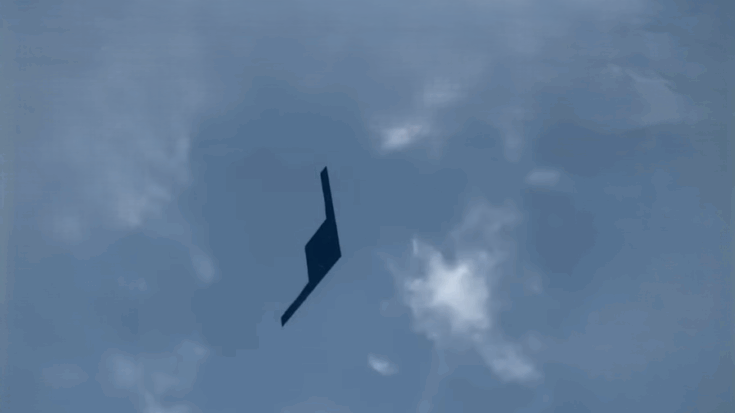
via onlarissa gr / YouTube
Late last week, residents and military observers near Larissa National Airport in central Greece witnessed an unusual sight: a bat‑shaped stealth aircraft executing an unscheduled landing. The aircraft’s shape and behavior sparked immediate speculation. Initial local reports identified it as a B‑2 Spirit stealth bomber, but later images and expert commentary have led some defense analysts to suggest it may instead be an RQ‑180 or a similar classified “flying wing” prototype. Regardless of its exact identity, the incident has drawn attention across military and aviation communities.
Military sources indicate the aircraft was forced down after a technical problem occurred during operations in the region. The asset now remains secured at the 110th Combat Wing under heightened protection. Specialized teams are expected to inspect and repair it before any further movement.
A Rare Stealth Appearance
Local media first labeled the mystery aircraft a B‑2 Spirit. The B‑2 is a long‑range stealth bomber developed for penetrating advanced air defenses and delivering precision strikes. Its smooth, wing‑only silhouette makes it one of the most recognizable flying wing designs in the U.S. inventory. In this case, however, the publicly released images lack certain visual hallmarks associated with confirmed B‑2 deployments, such as visible national markings or wingtip features.
Analysts from defense think tanks noted the possibility that the aircraft belongs to a newer program. The RQ‑180 is a high‑altitude, long‑range unmanned aircraft that reportedly shares the bat‑like profile seen in the Larissa footage. Little official information about the RQ‑180 has been released, adding to the mystery and debate over the landed aircraft’s true identity.
What is clear from military sources is that the landing was not planned. The aircraft touched down after experiencing a technical issue that made continued flight unsafe. Pilots and crew were reported to exit without injury, and security units quickly established a perimeter around the site.
Challenges of Stealth Aircraft Operations
Stealth aircraft like the B‑2 and similar flying wing drones are complex to operate. Their design uses advanced coatings and materials to reduce radar signature. This “stealth skin” must be maintained in controlled environments because exposure to humidity or extreme temperatures can degrade its properties. If the technical failure involves the exterior surface, repairs must often be done in clean‑room conditions found only at specialized bases.
In addition to environmental needs, stealth aircraft have strict requirements for runway strength and taxiway width. A B‑2’s wingspan measures 172 feet, wider than the length of many fighter aircraft. Pavement at a landing site must be capable of handling the bomber’s weight — more than 330,000 pounds when fully loaded — without damage. These limits usually restrict routine operations to select airfields with heavy‑load runways.
Stealth operations also involve significant logistical support, including portable hangars and specialized ground power units that supply correct electrical frequencies and cooling for internal systems. Finally, security is a major concern; advanced aircraft often require restricted perimeters and controlled access to protect sensitive systems.

The Road Ahead
Larissa Air Base has recently been upgraded to support U.S. operations involving other aircraft, such as MQ‑9 Reaper drones. Its infrastructure may have been sufficient to handle the emergency landing, but it lacks the full support network of regular stealth facilities. Until a recovery team arrives with tools and spare parts from the United States, the secretive flying wing will remain in place, drawing interest and scrutiny from both local observers and international defense analysts.






