

How an Ice Aircraft Carrier Won Churchill’s Approval During WWII
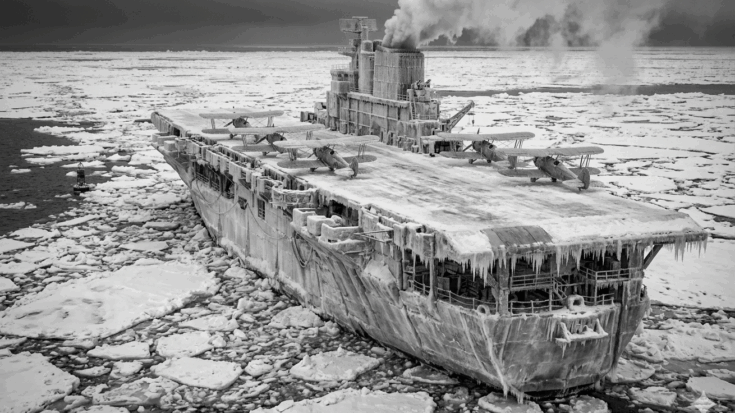
During the height of the Second World War, when German submarines threatened Allied shipping across the Atlantic, military planners explored ideas that stretched beyond conventional engineering. Among the most unusual proposals was a plan to build a massive aircraft carrier not from steel, but from ice. Known as Project Habakkuk, this concept emerged in 1942 and briefly gained serious attention from British leadership, including Prime Minister Winston Churchill.
The idea originated with Geoffrey Pyke, an unconventional British inventor known for creative problem solving. Pyke believed that a floating airfield made from a special material called pykrete could help protect vulnerable shipping lanes in the mid-Atlantic. At the time, long stretches of ocean remained beyond the reach of land-based aircraft, allowing German submarines to operate with relative freedom against merchant convoys.
The Promise of Pykrete
Pykrete, the key to Pyke’s proposal, was a mixture of water and wood pulp. This combination created a material stronger than ordinary ice and far more resistant to melting. When frozen, it could withstand impacts that would shatter plain ice, and it could be shaped using basic tools. These qualities suggested that a large floating structure might survive both harsh weather and enemy attack.
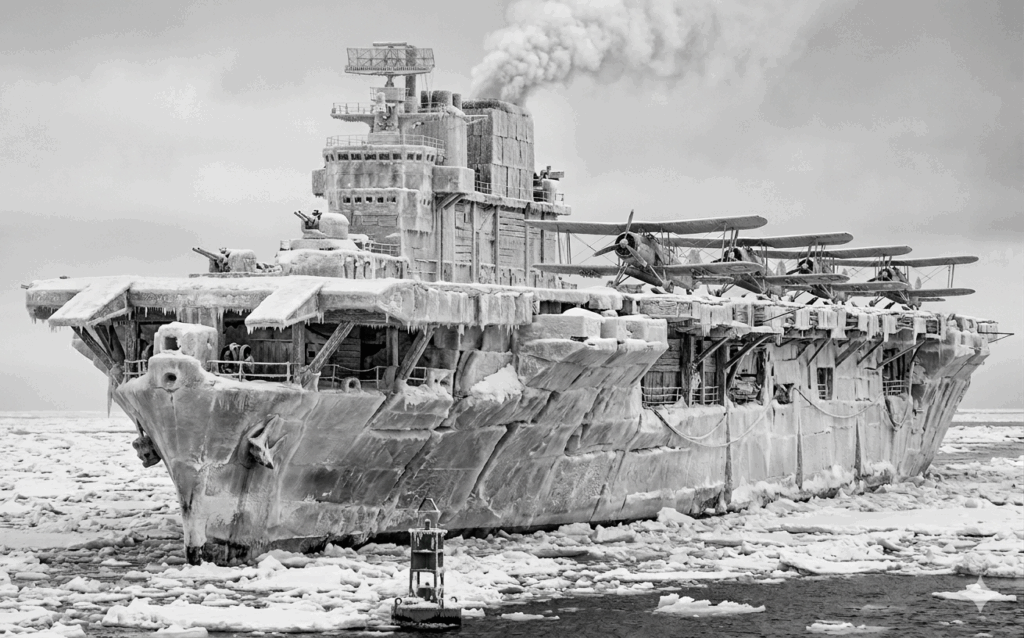
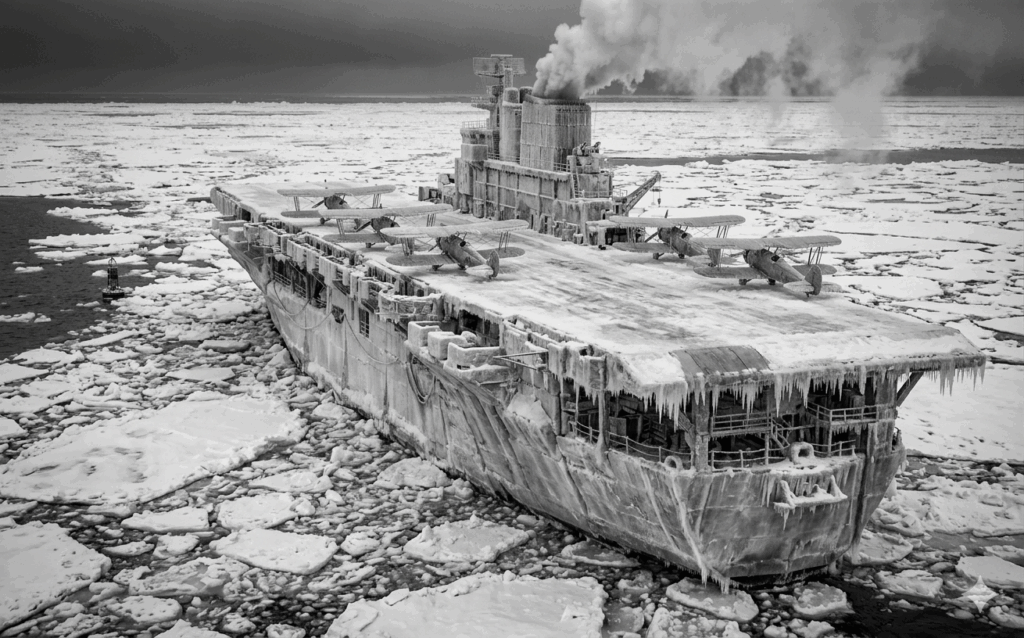
Pyke envisioned a vessel of immense size, far larger than any aircraft carrier then in service. Plans called for a structure roughly 2,000 feet long and capable of carrying hundreds of aircraft. Compared with typical wartime carriers, which displaced around 20,000 to 30,000 tons, this proposed “bergship” would weigh millions of tons. Churchill, known for his interest in innovative military ideas, approved further study after being shown a demonstration of pykrete’s durability.
Testing in Canada
Because of its cold climate and available resources, Canada became the center of experimental work on the project. Responsibility fell to Dr. C. J. Mackenzie of the National Research Council, who organized testing with support from engineers and universities. Early trials took place at Lake Louise before shifting to Patricia Lake in Alberta, where secrecy could be maintained.
By early 1943, workers constructed a scaled-down model on the frozen lake. The structure measured about 60 feet in length and weighed roughly 1,000 tons. To prevent melting during warmer months, engineers installed a refrigeration system that circulated cold air through the structure. The model successfully floated and demonstrated that pykrete could be used for large constructions, at least in controlled conditions.
Practical Challenges Emerge
Despite promising results, serious difficulties soon appeared. Maintaining a vessel of such size required an extensive cooling system, with pipes running throughout the structure to circulate chilled brine. This added significant complexity and cost, reducing the original appeal of simplicity. In addition, producing enough pykrete would demand vast quantities of wood pulp, placing strain on industries already supporting the war effort.
At the same time, advances in technology reduced the need for such an unusual solution. Long-range patrol aircraft, including models like the Short Sunderland, began closing the gap in Atlantic air coverage. Improved radar and coordinated convoy tactics also weakened the effectiveness of German submarine operations. As conditions changed, the strategic value of a floating ice carrier declined.
The End of an Unusual Plan
By mid-1943, support for Project Habakkuk faded. Although discussions continued briefly at high-level meetings, the program was eventually abandoned. The test structure at Patricia Lake remained in place for some time before slowly melting and sinking beneath the surface.
Today, traces of the experiment still rest on the lakebed, with fragments of piping and other materials marking the site. The project stands as a reminder of how wartime urgency encouraged bold ideas, even those that challenged the limits of engineering and practicality.






