How an Entire Bomb Group Was Lost in 29 Minutes
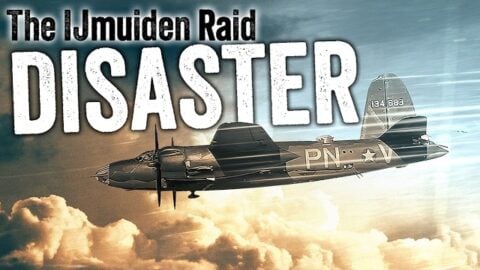
YouTube / TJ3 History
In the spring of 1943, the men of the U.S. 8th Air Force flew straight into one of the darkest chapters of the air war over Europe. Over the heavily defended port of IJmuiden, Holland, what was meant to be a precision strike turned into a nightmare.

In just minutes, German flak tore through the sky, and Luftwaffe fighters pounced, devastating an entire formation of B-26 Marauders. This is the story of the disastrous raids of May 14th and May 17th, 1943. These missions revealed the brutal cost of daylight bombing and left an indelible mark on the aircrews who survived, and lost in war.
A Dangerous Target on the Dutch Coast
In May 1943, the U.S. Eighth Air Force was still learning hard lessons about daylight bombing over occupied Europe. Confident in speed, tight formations, and the belief that well-flown aircraft could survive intense defenses, American planners sent B-26 Marauders. The Marauders went on a series of low-level attacks against heavily defended targets. Few missions would prove more catastrophic than the raids on IJmuiden, Holland, where an entire bomb group was effectively destroyed in less than half an hour.

IJmuiden was no ordinary target. The port guarded the entrance to the North Sea Canal, which led directly to Amsterdam, and was protected by some of the densest anti-aircraft defenses in occupied Europe. Massive coastal flak batteries, radar-directed guns, and nearby Luftwaffe fighter bases made any attack on the area extremely risky. Yet the target’s strategic importance convinced Allied planners that the risk was worth taking.
The B-26 Marauder Enters Combat
The Martin B-26 Marauder was a fast, modern medium bomber, but in 1943, it still carried a mixed reputation. Early models had earned the aircraft a reputation as difficult and unforgiving, and many crews were relatively inexperienced in combat conditions. Despite this, the Marauder was tasked with flying straight and level bombing runs at medium altitude- precisely the conditions that made aircraft vulnerable to concentrated flak.

On May 14th, a formation of B-26s crossed the Dutch coast and headed toward IJmuiden. Almost immediately, German gunners opened fire. Heavy, accurate flak ripped through the formation, shattering aircraft and breaking up the tight box formations that were vital for mutual defense. As damaged bombers fell behind, Luftwaffe fighters swooped in to finish them off. Within minutes, aircraft were exploding, ditching into the North Sea, or spiraling down in flames.
May 17, 1943: Disaster Repeated
Just three days later, the Eighth Air Force returned to the same target. The defenses were fully alert, and the outcome was even worse. German flak was devastatingly precise, and fighters met the bombers head-on. Entire flights were wiped out in rapid succession. In roughly 29 minutes of combat, the bomb group ceased to exist as an effective fighting force. Few aircraft escaped without damage, and losses were staggering.

Behind the statistics were aircrews who had trained together and trusted one another with their lives. Many crews were lost without ever firing a shot in self-defense. Survivors carried the memory of watching friends vanish in explosions or disappear into the sea, knowing there was little they could do to help.
Lessons Written in Blood
The IJmuiden raids shocked Allied commanders. The scale and speed of the losses forced an immediate reevaluation of tactics, altitudes, and the use of the B-26 in such heavily defended environments. Future missions would emphasize higher altitudes, better coordination, and improved fighter escort. Though these changes came too late for the men lost over IJmuiden, their sacrifice helped shape the air war that followed.

Overshadowed by later, larger bombing campaigns, the IJmuiden disaster remains one of the most devastating episodes in U.S. Army Air Forces history. In just 29 minutes, an entire bomb group was shattered- an enduring reminder of how quickly air combat could turn lethal, and how unforgiving the skies over occupied Europe were in 1943.