How Israel Executed Airstrikes on Iran Without Losing a Single Jet
YouTube / Republic World
In under 90 minutes, the Israeli Air Force executed one of the most complex air strikes in modern military history. More than 200 fighter jets, flying coordinated waves across 1,200 miles of contested airspace, systematically collapsed Iran’s integrated air defense network and buried its ballistic missile production infrastructure. Not a single Israeli aircraft was lost.
The Route In
The strike packages departed Israeli bases in tightly sequenced waves with lights dimmed for operational security. Rather than flying a direct southern approach, the formations climbed northeast, hugged the Syrian border at low altitude, and threaded through a pre-cleared corridor over central Syria and western Iraq. Allied airspace management had quietly opened that path hours in advance.

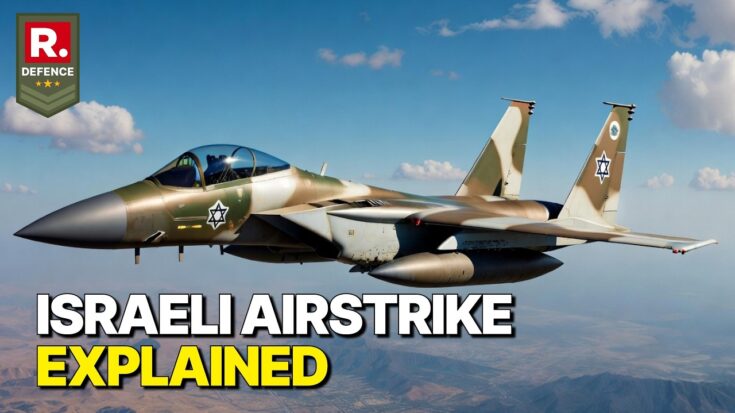
Israeli Boeing 707 tankers and a small number of US KC-46s had already positioned themselves over the eastern Mediterranean and northern Arabian Gulf. Strike aircraft topped off their fuel over Iraq, then split into specialized packages. F-35I Adirs pushed ahead to penetrate Iranian western defenses while heavier F-15I Ra’ams lagged behind, ready to launch standoff weapons once corridors were opened.
The Hidden Opening Act
Before a single manned jet crossed into Iranian airspace, the operation had already begun from within. Mossad operatives had pre-positioned drone swarms and vehicle-mounted launchers in the hills west of Kermanshah months earlier. Minutes before the main packages arrived, those assets activated. Low-observable quadcopters and loitering munitions rose silently and destroyed the engagement radars of Russian-supplied S-300 batteries guarding the western approaches.

The sudden radar blackout forced Iranian operators to activate backup systems, exposing their positions. F-35I Adirs were already in range. They released Rampage supersonic missiles that covered more than 200 kilometers in seconds, driving penetrator warheads into the remaining S-300 launchers and command posts around Kermanshah. Iran’s western air defense tier collapsed before most of its operators understood what was happening.
The Main Strike
With the outer layer gone, strike packages pushed into central Iran guided by airborne command platforms orbiting over Iraq. F-15I Ra’ams carrying ROCKS quasi-ballistic missiles struck underground missile production facilities at Parchin and Khojir east of Tehran from ranges exceeding 300 kilometers. The missiles executed high-speed pull-up maneuvers before driving downward into tunnels housing equipment essential for solid-fuel ballistic missile production.

Simultaneously, F-16I Sufas released Delilah cruise missiles against mobile launchers hidden across the desert. Spice 2000 glide bombs followed, pulverizing hardened storage bunkers and assembly halls at Shahrud and Karaj. Smaller munitions cleared surviving radar sites around Tehran’s suburbs. Every weapon in the strike package was chosen for a specific target type, and none of them overlapped.
The American Contribution
US Navy destroyers and Virginia-class submarines fired synchronized Tomahawk salvos from the Persian Gulf and Arabian Sea, targeting air defense batteries around Bandar Abbas and Bushehr that could have threatened the northern strike corridor.

Carrier-based F-35Cs and F/A-18s launched autonomous drones from the Gulf, keeping Iranian fighters grounded and radar operators saturated throughout the assault.
The Result
Five hundred targets across five provinces were struck in overlapping waves timed so precisely that Iranian command and control never regained situational awareness between them. By 4:00 a.m. local time, the last Israeli jets had reversed course, refueled over Iraq, and landed safely at home.

Entire S-300 regiments were inoperable. Missile production tunnels were buried under rubble estimated to require years of excavation. Launch brigades lost their operational vehicles in a single night.
The covert assets created the first cracks. The F-35 widened them. The heavier platforms finished the job. What Iran had spent decades building was gone before sunrise.