

The Italian Fighter That Nearly Matched the Spitfire
YouTube / AllthingsWW2
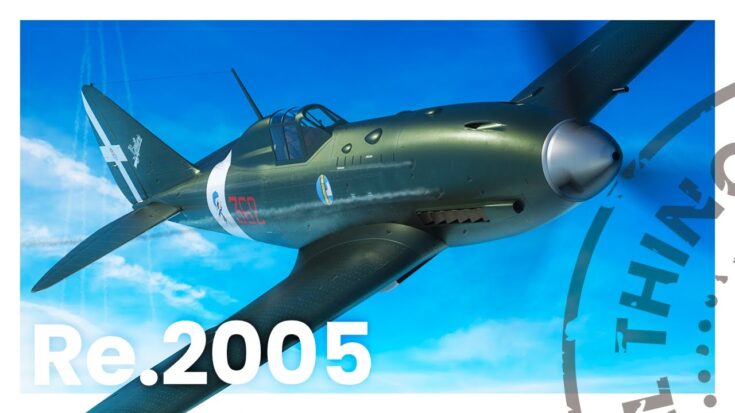
The Reggiane Re.2005 Sagittario entered service in mid 1943 as one of Italy’s Series 5 fighters, powered by the German DB 605 engine. Alongside the Fiat G.55 and Macchi C.205, it represented Italy’s final attempt to field a competitive front line fighter. Its operational impact was limited, but its design raised an important question. Was the Re.2005 a missed opportunity rather than a failure?

Handling and Flight Characteristics
Pilots consistently praised the Re.2005 for its handling. It was stable, responsive, and difficult to spin, with easy recovery if pushed beyond its limits. Much of this behavior came from its semi elliptical wing, which provided predictable lift and control. Italian pilots who flew combat over Sicily reported that it could hold its own against the Spitfire Mk IX at low altitude in turning combat.

Climb performance at lower altitudes was another strength. In this regime, the Re.2005 ranked among the best fighters of its time, making it well suited for interception duties close to the ground.
Armament and Attack Capability
Armament was one of the Sagittario’s strongest features. It carried three 20 mm cannons and two heavy machine guns, giving it significantly greater firepower than earlier Italian fighters. This made it effective against Allied heavy bombers, which increasingly dominated the skies over Italy in 1943.

Unlike its Series 5 competitors, the Re.2005 also had genuine fighter bomber potential. It could carry up to 1,000 kg of bombs, a load far beyond what the Spitfire Mk IX could manage. This gave the aircraft flexibility that Italy urgently needed as the war situation deteriorated.
Performance Limits and Structural Issues
Speed was respectable but not exceptional. Official figures placed it below the Spitfire Mk IX, although later testing suggested that with a proper German propeller and engine installation, the gap could have been narrower. At higher altitudes, the Re.2005 lost performance more rapidly than Allied fighters, limiting its effectiveness in air superiority roles.

More serious were its structural and reliability problems. Under certain dive conditions, the aircraft experienced dangerous vibration that nearly led to structural failure. These issues resulted in the fleet being grounded shortly before the Italian armistice. Combined with mechanical faults and high manufacturing labor requirements, the Re.2005 was ill suited for mass production.
An Aircraft That Arrived Too Late
In direct comparison, the Spitfire Mk IX held clear advantages in speed and high altitude performance, while the Re.2005 offered heavier armament and better strike potential. As a bomber interceptor and fighter bomber, the Sagittario showed promise. Strategically, however, Italy needed a fighter that could be built quickly, reliably, and in large numbers.

The Re.2005 was capable, but it was not transformative. By 1943, that distinction mattered.







