Macchi C.200 Saetta, Italian Lightning Bolt
YouTube / Greg's Airplanes and Automobiles
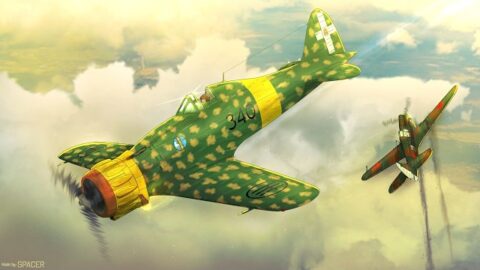
Sleek and agile, the Macchi C.200 Saetta cut a sharp figure across the Mediterranean skies. Early in the war, it proved more than capable of meeting Allied fighters on equal terms. In a one-on-one dogfight, the Italian thoroughbred could turn tightly, absorb punishment, and hold its own against its adversaries.
The Saetta was produced in too few numbers to shift the balance, and as the conflict escalated, it lacked the speed and firepower needed to challenge high-flying American bombers. What began as a promising contender ultimately became a symbol of Italy’s struggle to match its industrial power with its aerial ambitions.
A New Generation Takes Flight
When the Macchi C.200 Saetta, Italian for “Lightning Bolt”, first took to the skies in 1937, it marked a turning point for Italy’s fighter aviation. Designed by Mario Castoldi, the sleek monoplane replaced the biplanes that had dominated the Regia Aeronautica. With its low-wing layout, enclosed cockpit (on later variants), and retractable landing gear, the C.200 represented Italy’s leap into modern air combat on the eve of World War II.
Though early prototypes suffered stability issues, refinements soon transformed the aircraft into a reliable and well-balanced fighter. What emerged was not the fastest aircraft in Europe, but one that possessed admirable handling and rugged simplicity.
Built for the Dogfight
In combat, the C.200 earned respect for its agility. Its tight turning radius and responsive controls made it dangerous in close-range engagements, particularly against early-war Allied fighters over North Africa and the Mediterranean. Italian pilots appreciated its forgiving nature and structural strength, qualities that inspired confidence in the cockpit.
Powered by a radial Fiat A.74 engine, the Saetta was durable and less vulnerable to battle damage than liquid-cooled inline-engine fighters. It could operate from rough airstrips in desert conditions, an important advantage in the harsh environments of Libya and Egypt. However, its armament, typically two 12.7 mm Breda-SAFAT machine guns, was modest compared to the increasingly heavy firepower carried by Allied aircraft. As the war progressed, this limitation became more pronounced.
War Over the Mediterranean
The Macchi C.200 saw action on multiple fronts: France in 1940, the Battle of Britain (in limited numbers), North Africa, the Balkans, and even the Eastern Front alongside German forces. It performed solidly in early encounters, where skillful Italian pilots could hold their own in one-on-one combat.
In North Africa, the Saetta proved especially valuable. Its air-cooled engine handled desert heat well, and its sturdy construction allowed it to endure dust and sand that plagued more delicate designs. For a time, it was competitive against Hurricanes and other early Allied fighters. But the skies were changing rapidly. Newer Allied aircraft with greater speed, heavier armament, and improved high-altitude performance began to outclass the C.200.
Outmatched by Industrial War
While the Saetta was capable in a dogfight, it faced two challenges it could not overcome: numbers and evolution. Italy’s industrial capacity lagged behind that of Britain and the United States, limiting production. Fewer than 1,200 C.200s were built, hardly enough to dominate a theater of war.
More critically, the aircraft struggled to intercept high-flying American bombers once the U.S. entered the conflict. Its speed and climb rate were insufficient against heavily armed formations flying at altitude. What had once been a modern fighter soon became a stopgap until more advanced Italian designs, such as the Macchi C.202 and C.205, could take its place.
Legacy of the Saetta
The Macchi C.200 Saetta was not the most famous fighter of World War II, nor was it the most powerful. Yet it played a crucial role in ushering Italy into the era of modern monoplane combat aircraft. It laid the foundation for the more refined and formidable Macchi fighters that followed.
Above all, the Saetta embodied a moment of transition, when courage and maneuverability could still compensate for limited firepower and industrial might. For a brief time in the early war years, Italy’s “Lightning Bolt” flashed brightly across the Mediterranean sky.