How Good Was Japan’s Answer to the Bf 109
YouTube / Australian Military Aviation History
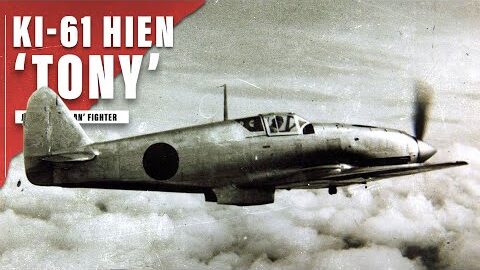
The Kawasaki Ki-61 Hien stands apart in the history of Japanese military aviation as one of the most distinctive fighters of World War II. Often mistaken by Allied pilots for a Messerschmitt Bf 109 or an Italian Macchi C.202, the Ki-61 earned the Allied codename “Tony” due to its sleek, European appearance.
Unlike most Japanese fighters of the era, which relied on air-cooled radial engines, the Ki-61 was powered by a liquid-cooled V-12 engine, making it a rare and technically ambitious design within Japan’s wartime aircraft lineup.
Background and Development
The origins of the Ki-61 trace back to Japan’s growing need for a more modern and survivable fighter during the late 1930s, particularly as combat intensified during the Sino-Japanese War. Kawasaki, having experience with liquid-cooled engines, secured a license to produce the German Daimler-Benz DB 601 engine. The Japanese-built version, designated the Ha-40, produced around 1,175 horsepower and gave the aircraft its streamlined nose and high-speed potential.
Designed between 1939 and 1941, the Ki-61 was conceived as a lightweight yet robust air superiority fighter. It contrasted sharply with the lightly built Mitsubishi A6M Zero, emphasizing pilot protection and durability. The aircraft incorporated self-sealing fuel tanks, armor plating, and fuel injection, features uncommon in Japanese fighters at the time. Its first flight in December 1941 showed promise, and by 1942, it outperformed several competitors in comparative trials, including the Bf 109E and P-40E.
Combat Service
The Ki-61 entered operational service in late 1942 and quickly made its presence felt across the Pacific. It saw action during the defense of Japan following the Doolittle Raid, as well as in New Guinea, the Philippines, and around Rabaul. Allied pilots were surprised by its performance; unlike many Japanese aircraft, the Ki-61 could dive at high speed, absorb damage, and retain good climb capability.
Armed with two 12.7 mm Ho-103 machine guns and later supplemented by heavier cannons, the Hien proved effective against both bombers and fighters. Its durability and fire resistance led U.S. pilots to request more P-38 Lightnings, which could better match its speed and climb. The Ki-61’s European-like handling and ruggedness earned it respect, even as Allied air superiority steadily increased.
Problems and Limitations
Despite its strengths, the Ki-61 suffered from persistent engine troubles. The Ha-40 was difficult to manufacture and highly sensitive to poor-quality fuel and maintenance conditions common in the later years of the war. Tropical climates worsened reliability, and shortages of spare parts further grounded aircraft. Later variants, such as the Ki-61-II, attempted to improve performance but were hampered by continued engine failures.
These challenges ultimately led to one of the most remarkable improvisations of the war: the Ki-100, created by fitting a reliable radial engine onto the Ki-61 airframe. Ironically, this emergency conversion produced one of Japan’s best late-war fighters.
Legacy and Comparison to the Bf 109
Though often compared to the Bf 109 due to its appearance and engine layout, the Ki-61 had a distinct operational philosophy. It emphasized survivability and balance rather than sheer speed. While it could not match late-war Allied fighters like the P-51 Mustang or F6F Hellcat, the Ki-61 remained a capable and respected interceptor.
Ultimately, the Ki-61 Hien represented Japan’s effort to integrate European engineering concepts with domestic design. Though ultimately outclassed, it remains one of the most fascinating and misunderstood fighters of World War II- an aircraft that stood apart in both form and function.