New Footage From Greece Reveals the US Air Force’s Most Secretive Drone
CREDIT: Instagram / @timosnyc
New video footage captured in Greece has given the clearest look yet at one of the US Air Force’s most secretive aircraft, a classified stealth drone widely referred to as the RQ-180, and the images are raising fresh questions about where it is operating and why.
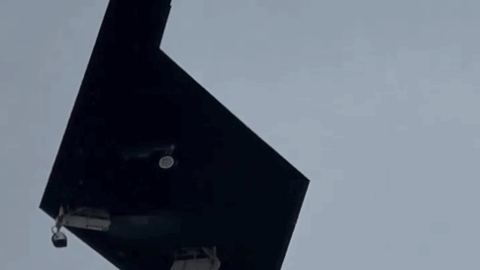
The footage, shot by a local observer near Larissa Air Base in central Greece, shows the aircraft on approach to land, providing a near-direct view from underneath the airframe. It is the most detailed imagery yet of a drone that the US government has never officially acknowledged.
View this post on Instagram
What the Footage Reveals
The new angle confirms several details that were previously unclear or subject to speculation. The aircraft’s landing gear configuration is now plainly visible, ruling out any possibility that the drone is a B-21 Raider, a comparison that had been floated given the similarity in planform between the two aircraft. Also visible is what appears to be a large transparent aperture fitted flush to the belly of the airframe, consistent with a sensor port for visible light or infrared imaging equipment.
View this post on Instagram
Control surfaces are also clearly in action in the footage. Flaperons are visible on each wing, along with a rear fuselage control surface similar to the one found on the B-2 Spirit, where it is known as the Gust Load Alleviation System. The configuration reinforces the aircraft’s lineage as a Northrop Grumman flying wing design, most likely developed at Plant 42 in Palmdale, California.
Beyond optical sensors, analysts believe the RQ-180 is likely equipped with synthetic aperture radar and signals intelligence collection systems, with sensor payloads potentially interchangeable depending on mission requirements.

A Regular Presence at Larissa
The earliest footage from the same observer was published in mid-March, with more recent video dated within the past 24 hours showing overcast skies rather than the clear conditions seen in earlier clips, suggesting the aircraft has been returning to Larissa regularly rather than diverting there as a one-time emergency.
That pattern is supported by flight tracking data. Multiple C-17 transport flights have been recorded traveling from Edwards Air Force Base in California, near the Palmdale facility where the RQ-180 is believed to have been developed, directly to Larissa, with the most recent arriving and departing on April 6.
View this post on Instagram
Larissa also has two isolated hangars, constructed within the last few years according to satellite imagery, located away from the rest of the airfield’s activity. US MQ-9 Reapers based at Larissa operate from separate facilities to the north, leaving the purpose of those hangars unexplained by any known aircraft.
Why Greece, and Why Now
Larissa had not previously been considered the most likely forward base for the RQ-180 in Europe. RAF Akrotiri on Cyprus and Naval Air Station Sigonella in Sicily had both been seen as better candidates given their coastal positions and existing infrastructure for sensitive operations. Larissa offers different advantages, including added flexibility for missions over the Black Sea and Greece’s strict restrictions on aircraft spotting near military installations provide a layer of operational security that is harder to maintain at more exposed locations.

With the Iran conflict ongoing, the focus of any missions flown from Larissa has almost certainly shifted toward that theater. The RQ-180’s range and stealth characteristics make it well suited for intelligence collection over denied airspace, exactly the kind of environment that has defined the air campaign over Iran.
The drone is believed to have been in frontline service for a number of years. An official government acknowledgment has been discussed as a possibility in defense circles for some time, but none has come. For now, it is the footage from a Greek airfield, and not any announcement from Washington, that is slowly pulling back the curtain on one of American aviation’s best-kept secrets.