The WW2 Propeller Plane that Outlived Most Jet Aircraft
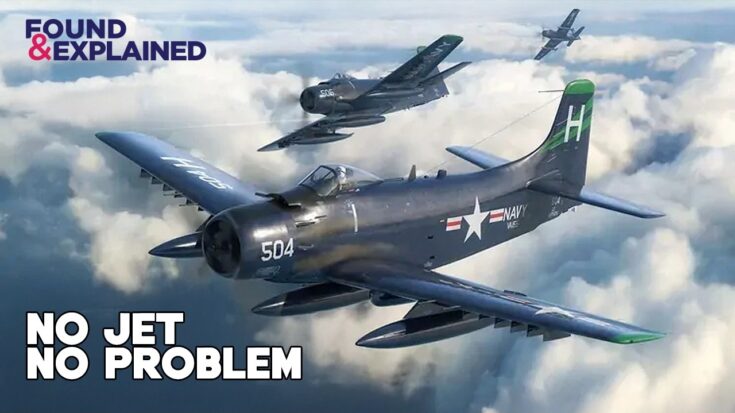
YouTube / Found And Explained
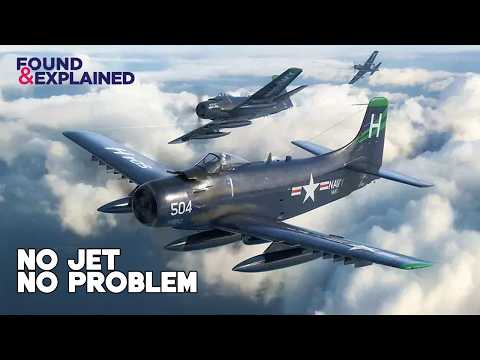
The A-1 Skyraider began as a World War II requirement for a single seat carrier based strike aircraft. It first flew in 1945, too late for the war it was designed to fight, yet it remained relevant for the next three decades.
Its large R-3350 radial engine, long range, and ability to haul heavy bomb loads shaped an aircraft that delivered strong performance from the deck of a carrier or from forward air bases. Early tests showed that its range, payload, and accuracy filled a role that later jets could not easily reproduce.
Engineering for Endurance and Payload
Douglas engineers focused on power, efficiency, and weight control. They removed the internal bomb bay and shifted all weapons to the wings. They cut weight from the fuel system, reworked the dive brakes, and trimmed unnecessary components.

By the time the first AD series aircraft reached the fleet in 1946, the design had lost more than 1800 pounds. This work produced a slow but reliable strike aircraft that carried nearly 8000 pounds of ordnance with a range of roughly 1500 miles. It could remain over a target area long after jets needed to return to base.
Proven in Korea
The Skyraider first entered combat in 1950. Its long endurance and large bomb load made it valuable in the close air support role. It carried out bombing runs, rocket attacks, and even an aerial torpedo strike against the Hwachon Dam in 1951.

Pilots relied on the aircraft to absorb damage and return to the carrier. Marines and Navy crews used it heavily in low altitude operations that required accuracy and resilience. As losses mounted, armor plates were added. Even with added protection, it still carried larger loads than most jets of the era.
A Combat Veteran in Vietnam
The Skyraider entered the Vietnam War as one of the last piston engine aircraft in American service. It flew the first Navy strikes after the Tonkin Gulf incident and took on a mission that brought it lasting recognition.

Air Force crews used it in the Sandy role to protect rescue helicopters. Its slow speed allowed pilots to identify threats and place accurate fire on hostile positions. Major Bernard Fisher’s rescue of a fellow pilot in 1966 illustrated how the aircraft supported dangerous recovery missions.
The Toilet Bomb and Air to Air Combat
A unique event occurred in 1965 when Commander Clarence Stoddard carried a porcelain toilet fitted with fins as a symbolic drop for delivering the six millionth pound of ordnance. The moment was filmed by his wingman and became part of Skyraider lore.

The aircraft also achieved an air to air victory when a flight of A-1s defended a rescue mission and shot down a MiG 17 using their 20 mm cannons. Low altitude maneuverability and strong construction allowed the aircraft to survive encounters that favored speed in theory but rewarded stability in practice.
Final Years and Continued Service Abroad
South Vietnamese crews flew the Skyraider until the fall of Saigon in 1975. Some aircraft escaped to Thailand carrying refugees inside the fuselage. Others were destroyed or captured on the ground. The type also served with French forces and the Royal Navy in roles that used its combination of range and lift capacity.