What Happened to the Luftwaffe Planes After WW2
YouTube / History Inside
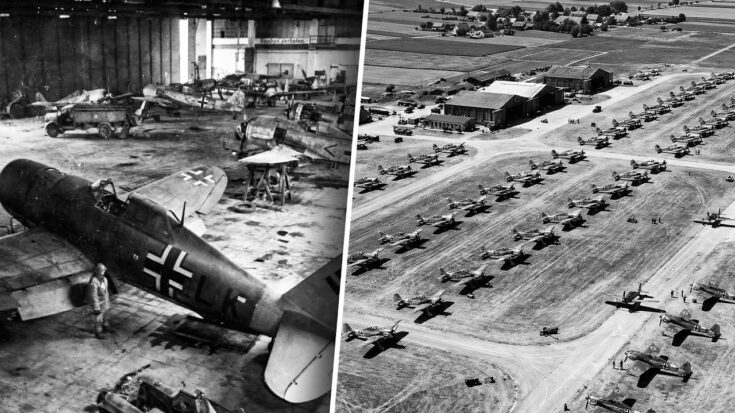
In May 1945, Germany surrendered and the Luftwaffe stopped functioning as an organized force. Thousands of aircraft sat abandoned on airfields that stretched from Norway to Austria. Fuel shortages, collapsing command structures, and destroyed infrastructure meant most units had not flown for weeks. When the war ended on , airfields held everything from worn out Bf 109s to jet powered prototypes that hinted at future designs.

Allied teams found crowded hangars at Prague, damaged aircraft at Lübeck, and experimental projects at Rechlin. These sites contained airframes, wind tunnel models, and technical documents that showed how far German jet and rocket research had progressed. Many aircraft remained untouched because crews had simply run out of fuel during the war’s final days.
Allied Missions to Capture German Technology
Once the surrender took effect, the Allies began collecting advanced aircraft. The United States moved quickly with Operation LUSTY. Colonel Harold Watson’s teams searched Germany, Austria, and Czechoslovakia to secure valuable jets and prototypes. Me 262s from Lechfeld and Arado bombers from Denmark were shipped to Wright Field in Ohio or to Freeman Field in Indiana for detailed evaluation.

Britain launched Operation Surgeon, which focused on both aircraft and the engineers who designed them. Teams from the Royal Aircraft Establishment gathered documents and interviewed surviving personnel. Captured aircraft such as the Me 262 and He 162 were flown at Farnborough for performance testing.

The Soviet Union advanced through Saxony, Silesia, and Czechoslovakia with its own trophy brigades. Factories, tools, engineers, and airframes were shipped east for study. Soviet designers examined the Me 262 and Ar 234 to support early jet programs. Competition for prized prototypes soon emerged among the Allies, especially in central Germany where forces arrived within days of each other.
The Systematic Destruction of Remaining Aircraft
By late 1945, the Allied Control Council ordered the elimination of all remaining German aircraft. The most valuable examples had already gone to research programs. Everything else was dismantled or scrapped between 1945 and 1948. Airfields such as Flensburg, Grove, and Lübeck became disposal centers where fighters, bombers, and prototypes were crushed for metal.

Recycling supported Europe’s recovering industries, and scrapping work provided employment in a difficult period. Some aircraft were burned or sunk offshore and remain underwater today. Civil aviation types such as the Ju 52 were sometimes kept for transport roles, but most were eventually dismantled. Historians continue to debate how many irreplaceable airframes were lost because storage space did not exist.
Foreign Service and the Few Survivors
A small number of aircraft entered post war service abroad. Czechoslovakia built the Avia S 199 from leftover parts. Spain continued licensed production of the HA 1112. Norway and France also operated German designs for limited periods. As spare parts disappeared, these fleets retired and most airframes were scrapped.

Only a small fraction of Luftwaffe aircraft survive today. Museums display examples of the Me 262, Bf 109, Fw 190, and Ar 234. Most restorations rely on multiple wrecks to create a single exhibit. The few that remain stand as reminders of a force that once covered Europe and then vanished in just a few years.