How the RAAF’s B-24 Liberators Helped Win the Air War in the Pacific
YouTube / Australian Military Aviation
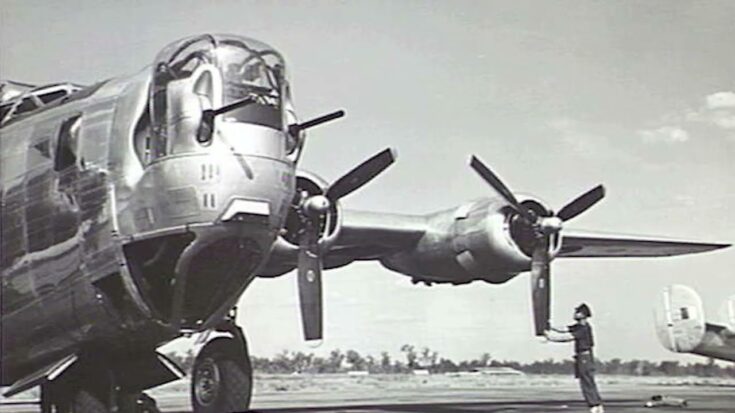
First flown in 1939, the B-24 became the most-produced American aircraft of World War II, with more than 18,000 built. Production was so intense that at Ford’s massive Willow Run plant in Michigan, Liberators were completed at a rate approaching one per hour. This industrial output supplied the United States, the Royal Air Force, and beginning in early 1944, the Royal Australian Air Force.

American Foundations in Australia
American B-24 units began operating from Australia in late 1942, flying from Queensland and Northern Territory bases. Their long range allowed strikes deep into Japanese-held territory, including Borneo and the Netherlands East Indies. These early operations demonstrated the Liberator’s ability to reach distant targets while carrying meaningful bomb loads.
RAAF aircrew gained early experience with B-24s by flying with RAF and USAAF squadrons in Europe, North Africa, and the Pacific. These crews brought valuable operational knowledge back to Australia, forming the nucleus of Australia’s own Liberator force.

Building an Australian Liberator Wing
In 1944, experienced RAAF crews entered formal training programs, flying combat missions with American units before returning to Australia. The center of this effort became RAAF Tocumwal in New South Wales. There, former USAAF Liberators were used to train aircrew and ground staff ahead of large-scale deliveries.
Three squadrons, Nos. 21, 23, and 24, were formed into No. 82 Wing RAAF. From Northern Territory bases, these squadrons began combat operations in mid-1944. Within months, Tocumwal had become the RAAF’s largest training unit, supporting a rapidly expanding Liberator force.

Combat Across the Southwest Pacific
RAAF B-24s focused on long-range maritime patrols and attacks on Japanese shipping in the Timor, Arafura, and Banda Seas. They also struck airfields, supply depots, and infrastructure across Timor, the Celebes, Borneo, and the Netherlands East Indies.
Some of the most dangerous missions involved low-level attacks on heavily defended targets, including power stations in Java and Japanese naval vessels. These operations exposed crews to intense fighter opposition and anti-aircraft fire, resulting in heavy losses.

Special Duties and Final Campaigns
Specialized units such as No. 200 Flight carried out covert missions, inserting special operations personnel behind enemy lines. These missions supported resistance forces and intelligence efforts across occupied territory.
In mid-1945, No. 82 Wing moved forward to Morotai to support the Oboe landings in Borneo. Liberators flew pre-invasion strikes and provided direct support for amphibious operations at Tarakan, Labuan, and Balikpapan. These missions marked the peak of the RAAF Liberator campaign.

Cost and Legacy
RAAF Liberator units lost 169 men and 14 aircraft during their brief but intense operational service.

After the war, Liberators helped return Australian prisoners of war home. In 1947, the type was replaced by the Australian-built Lincoln bomber. Today, the sole surviving RAAF Liberator preserved in Victoria stands as a reminder of the aircraft’s role in Australia’s Pacific war.