Japan Never Expected B-25 Eight-Gun Noses to Saw Ships Apart
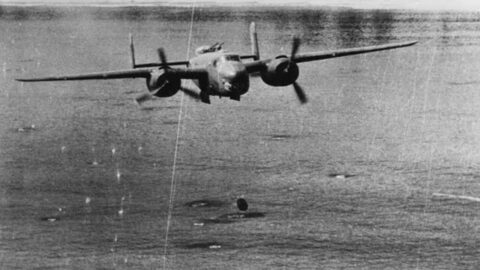
YouTube / WWII Battlefield Memoirs and Mossad Operations
A Calm Morning Before Disaster
At dawn on March 3, 1943, the Bismarck Sea appeared calm and undisturbed. Rear Admiral Masatomi Kimura stood on the bridge of his flagship, overseeing a convoy of eight destroyers escorting eight fully loaded transport ships bound for Lae, New Guinea. Nearly 7,000 soldiers of the Japanese 51st Division were aboard. They were urgently needed by Lieutenant General Hatazō Adachi’s forces fighting a grinding jungle campaign in New Guinea.
From Kimura’s perspective, the mission carried risk but remained acceptable. Japanese convoys had operated in these waters for more than a year with limited losses. American surface forces were not present, and previous Allied air attacks had failed to stop fast, well-escorted ships. Japanese naval doctrine, reinforced by early war successes, suggested the convoy would reach its destination. What Kimura did not know was that Allied air tactics in the Southwest Pacific had changed.
Why Earlier Air Attacks Failed
For months, Allied air power struggled to stop Japanese shipping. High-altitude B-17 attacks looked impressive but rarely struck maneuvering ships. Medium-altitude bombing gave captains time to evade. Torpedo attacks required long, straight runs that exposed aircraft to intense anti-aircraft fire. Again and again, Japanese convoys absorbed damage and continued on.
Japanese officers were confident in their defenses. Captain Tameichi Hara of the destroyer Shigure had watched American bombs splash harmlessly into the sea while attacking aircraft were shot down. The Imperial Japanese Navy relied on tight formations, aggressive maneuvering, overlapping gunfire, and fighter cover from bases such as Rabaul. Vice Admiral Gunichi Mikawa approved the Lae convoy knowing it would be detected, but believing the Allies still lacked a reliable method to destroy it. That belief proved incorrect.
A New Way to Attack Ships
In Australia, American aircrews and ground crews developed a different approach. If bombs could not reliably hit ships from above, aircraft would attack from close range. The B-25 Mitchell became the ideal platform. Its glass bombardier nose was reinforced or removed, and multiple .50 caliber machine guns were installed in the forward fuselage. Some aircraft carried six forward firing guns, others carried eight.
These modified B-25s were designed to attack at mast height. They approached just above the waves, firing continuously as they closed on their targets. The machine guns were not meant to sink ships directly. Their role was to kill gun crews, damage bridges, disrupt fire control, and suppress anti-aircraft defenses long enough for bombs to be delivered with precision. Japanese crews had never faced this kind of attack.
The Convoy Is Destroyed
When Allied aircraft reached Kimura’s convoy, the attacks came in coordinated waves. High-altitude bombers struck first, forcing ships to scatter. Then the B-25s arrived at low level. Flying straight at the ships, their forward guns blazing, the Mitchells raked decks and superstructures. Anti-aircraft fire weakened as crews were killed or driven into cover.
Moments later, bombs were released at extremely close range. Some skipped across the water into hulls. Others struck directly. Transport ships caught fire and sank quickly. Destroyers maneuvered desperately, attempting to rescue survivors while under constant attack. Allied aircraft returned repeatedly, ensuring damaged ships could not escape.
By the end of the battle, all eight transport ships and four destroyers were sunk. Thousands of Japanese soldiers died before reaching land. Admiral Kimura survived, but the convoy had been annihilated.
A Shift in Naval Warfare
The Battle of the Bismarck Sea marked a major change in naval warfare. Japanese planners had prepared for bombs from above and torpedoes from below. They had not prepared for aircraft that attacked at eye level, combining heavy gunfire with precise bombing.
After the battle, daylight Japanese resupply operations in the Southwest Pacific became nearly impossible. Allied air power now dominated the sea lanes. Low-level, heavily armed strike aircraft became central to anti-shipping operations.
The eight gun nose B-25 was not refined or elegant. It was direct and destructive. Over the Bismarck Sea, it demonstrated a new reality of modern warfare. Ships no longer needed to be found by fleets. They could be hunted and destroyed from the air.