

What Made Spitfire a Masterpiece of Engineering
YouTube / Not What You Think
The Supermarine Spitfire remains one of the most technically refined fighter aircraft of the Second World War. Designed under extreme pressure and produced in enormous numbers, it combined aerodynamic efficiency, mechanical simplicity, and pilot focused ergonomics in ways few wartime aircraft managed to achieve. Even decades later, its engineering choices still stand out.
Designed for the Pilot
Climbing into a Spitfire cockpit reveals how carefully the aircraft was laid out. Despite its compact fuselage, the cockpit is functional and surprisingly accommodating. The control column is one of the aircraft’s most distinctive features. Unlike most fighters, only the upper portion of the stick moves laterally. This design prevents interference with the pilot’s legs and allows precise control during aggressive maneuvering.

Control forces were deliberately kept light. Both the elevators and rudder used horn balances, reducing the physical effort required to move the control surfaces. This mattered during prolonged combat, where fatigue could become as dangerous as enemy fire. Pilots consistently reported that the Spitfire felt natural and responsive, even near its performance limits.
Aerodynamics That Defined an Era
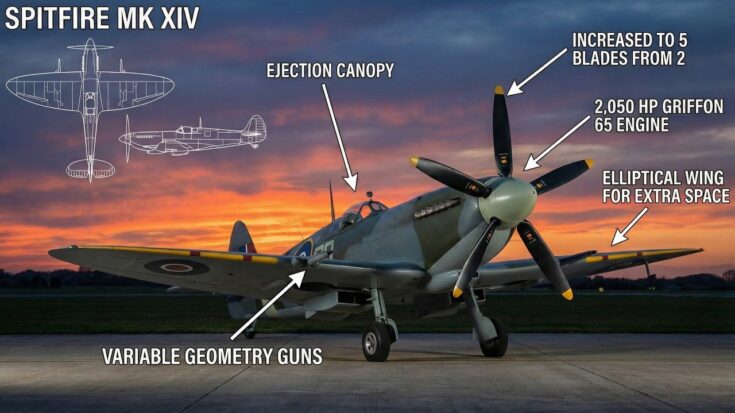
The Spitfire’s elliptical wing was not chosen for aesthetics. Its shape reduced induced drag and distributed lift efficiently across the span. This allowed the aircraft to retain excellent maneuverability while maintaining high speed. As engine power increased throughout the war, the airframe adapted without losing balance or handling quality.

Later variants, such as the Mark XIV, paired the refined airframe with more powerful engines and larger propellers. Five bladed propellers replaced early two bladed designs to convert increased horsepower into usable thrust. With nearly 2,000 horsepower available, the Spitfire could climb aggressively and perform vertical maneuvers few propeller driven fighters could match.
Precision Over Volume
Spitfire armament reflected engineering tradeoffs rather than excess. Early variants carried eight .303 caliber machine guns, while later models combined .50 caliber machine guns with 20 mm cannons. Ammunition capacity was limited by weight constraints, forcing pilots to rely on accuracy rather than sustained fire.

The guns were mounted at an angle so their streams converged at a preset distance, typically around 750 feet. This concentrated firepower into a tight pattern capable of inflicting decisive damage in seconds. Most missions lasted under an hour, with pilots having only a handful of brief firing opportunities before needing to return and rearm.
Simple Systems That Worked
The Spitfire relied almost entirely on mechanical systems. Control cables and pulleys ran through the fuselage, delivering smooth and predictable responses. Trim systems were carefully engineered, including the rudder’s distinctive Z shaped trim tab, which prevented sudden changes in yaw control. Even cockpit lighting featured adjustable fabric covers to preserve night vision.

This simplicity extended to maintenance. Specialized tools and time intensive panel removal reflected the aircraft’s tight tolerances and lightweight construction. Every design decision prioritized performance and reliability over convenience.
A Proven Combat Design
Although the Hurricane accounted for more enemy aircraft destroyed during the Battle of Britain, the Spitfire offered superior speed, climb rate, and high altitude performance. These qualities made it the Luftwaffe’s most respected opponent and ensured its continued development throughout the war.

The Spitfire succeeded because its engineering balanced power, control, and efficiency without unnecessary complexity. It was not just a successful fighter. It was a carefully built solution to the demands of aerial combat, refined through experience and executed with precision.







