When Spitfire Pilots Went Wing-to-Wing With V-1 Flying Bombs
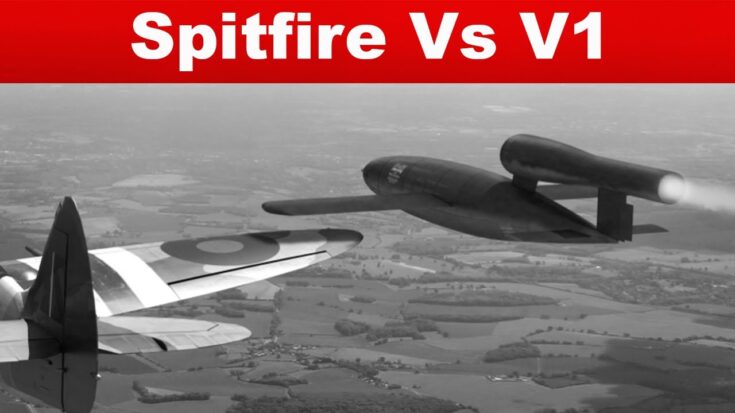
YouTube / World War Military History
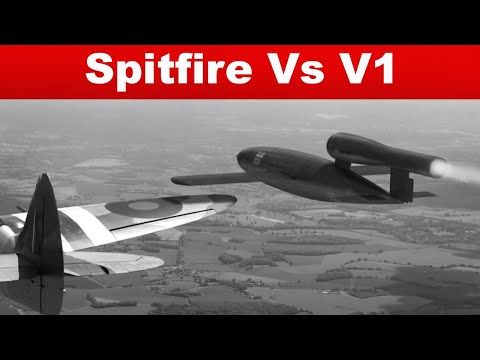
One week after D-Day, Germany began launching a new weapon at London. The V1 flying bomb arrived without a pilot, without warning, and with a ton of explosives in its nose. Starting June 13, 1944, dozens fell on the city in the first week alone. The Royal Air Force scrambled to stop them, and what followed produced some of the most unusual combat flying in the entire war.
The Problem With Shooting Them Down
The V1 was a pilotless monoplane powered by a pulsejet engine that produced a distinctive droning roar audible from the ground. It carried a simple gyroscope guidance system and flew at 640 kilometers per hour. The psychological effect was compounded by the engine’s behavior: when the fuel ran out, the motor cut off. The silence that followed lasted only seconds before the warhead detonated.

Intercepting a V1 required catching it first. Early Spitfire variants powered by the Rolls-Royce Merlin engine couldn’t reliably close the gap. The solution was the Rolls-Royce Griffon, which produced up to 2,035 horsepower in later configurations compared to roughly 1,440 horsepower from earlier Merlin variants. Griffon-equipped Spitfires reached 661 kilometers per hour, enough to catch the bomb. Getting alongside one was the easy part of what came next.
The Wing Tip Maneuver
On June 23, 1944, Australian Flying Officer Kenneth Roy Collier of 91 Squadron spotted a V1 over southern England and gave chase in Spitfire NM698. He fired a short burst with no effect. He fired again and exhausted his ammunition. The V1 kept flying toward London.

Collier knew the V1’s gyroscope kept it stable and on course. He also knew that disrupting that gyroscope might be enough to bring it down without guns. He edged his wing tip under the flying bomb’s wing and flipped it over. The V1 continued flying, now inverted, on the same heading. Collier made a second pass and executed the maneuver again. This time the 2,000-pound warhead went into a spin and hit the ground near East Grinstead at 8:40 pm. It exploded in an open field and caused no casualties.

Other RAF pilots adopted the technique after Collier demonstrated it worked. Tipping a V1 required flying close enough to a live warhead traveling at over 600 kilometers per hour to physically touch it with the aircraft’s wing, then applying precise control inputs without triggering a detonation or losing control of the Spitfire.
The Broader Campaign
Over 10,000 V1s were launched at England during the campaign. Roughly 1,000 were destroyed by RAF pilots through a combination of gunfire and the wing-tip method. The threat was temporarily ended in September 1944 when advancing Allied ground forces overran the launch sites on the French coast. The final V1 to strike British soil landed in Hertfordshire on March 29, 1945.

The V1 campaign produced some of the most unconventional flying the Spitfire was ever asked to perform. The aircraft was designed to fight other aircraft. Against the V1, pilots adapted their tactics in real time, and one of those adaptations required more precision and nerve than almost anything a conventional dogfight demanded.