What the Symbols on WWII Combat Aircraft Actually Meant
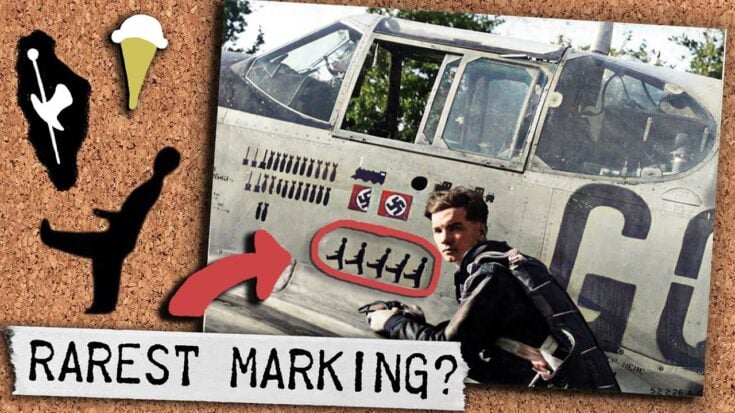
YouTube / TJ3 History
Every marking painted on a WWII combat aircraft told a story. Some were straightforward. Others required knowing a specific piece of cultural context to decode. A few remain unexplained entirely. Together they form one of the most detailed visual records of individual combat achievement the war produced.
Bomber Tallies

The bomb symbol was the most common marking on heavy and medium bombers, added after each completed mission. Simple enough, but variations carried additional meaning. A star added to a bomb indicated the aircraft had flown that mission as the lead ship. A heart represented a crew member wounded in action, one of the rarest additions to any bomber’s record. Occasionally the name of the target city appeared inside the bomb itself.
One symbol found almost exclusively on Royal Air Force bombers was the ice cream cone. Before the war, Italian immigrants in Britain were closely associated with running gelato shops, and the association stuck. An ice cream cone on an RAF bomber meant a mission to Italy.
Transport aircraft carried their own distinct markings. A camel painted on the side indicated a mission flown over the Hump, the Himalayan route between India and China used to supply Allied forces in the China-Burma-India theater. A duck represented a decoy mission, flown to draw Luftwaffe fighters away from a real raid headed elsewhere. These missions often turned back before enemy contact, but some groups tallied them anyway.
Fighter Markings

Air-to-air kills on fighter aircraft were typically represented by enemy flags, roundels, crosses, or swastikas, varying by unit and theater. Some pilots used half symbols for shared claims. Bomber gunners added their own kill markings, most visibly on aircraft like the Memphis Belle.
A handful of pilots went further in distinguishing their records. One P-47 pilot of the 56th Fighter Group used red crosses for ground kills and white ones for air-to-air victories, tracking both categories separately and reaching ace status in each. In the Pacific theater, pilots more commonly used aircraft silhouettes, with single-engine shapes for fighters and twin-engine shapes for bombers.
Navy and Marine pilots generally didn’t mark their aircraft at all. Those branches were stricter about nose art and personal markings, and pilots rarely flew the same aircraft consistently enough to build a tally. The exception was kill markings for high-scoring aces, where propaganda and morale value outweighed policy. Carrier island towers were more commonly painted with victory records than the aircraft themselves.
Mission Identifiers

American fighter pilots in Europe developed a specific set of symbols for mission types that went beyond simple kill counts. A broom indicated a fighter sweep. An umbrella marked a top cover mission, sometimes with a bomb added beneath it if the cover was flown for a bombing raid. A top hat with a cane represented a successful escort mission. These markings weren’t universal across units, but enough groups used them consistently that they appear regularly in period photography.
Some symbols remain unidentified. One P-51 named Atlanta Peach carried five walking silhouettes beneath the cockpit whose meaning has never been confirmed. A Halifax named Pinocchio displayed a swastika at its 21st mission position rather than a bomb, with no documented explanation for the substitution.

The markings that have been decoded tell a detailed story of what these crews did and where they went. The ones that haven’t serve as a reminder that the full record of what happened over Europe and the Pacific is still not entirely written.