U.S. B-52s Depart RAF Fairford Fully Loaded with JDAM Strike Payloads
@LHA2709 / X
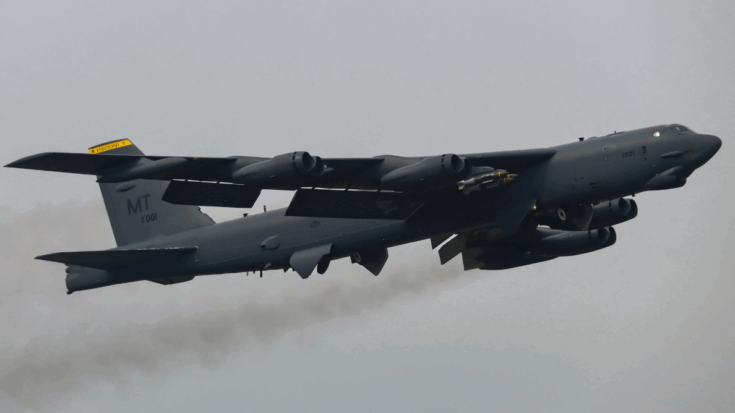
U.S. Air Force B-52H Stratofortress bombers operating from RAF Fairford in the United Kingdom have recently shifted their weapons configuration, marking a visible change in ongoing bomber operations linked to missions in the Middle East. After several weeks carrying only long-range cruise missiles, the aircraft are now departing with large precision-guided bombs mounted under their wings.
The change reflects how air campaigns often evolve as military planners adjust tactics and weapons to match operational needs. Observers and aviation photographers documented the new configuration in March 2026, providing rare public insight into how these strategic bombers are being employed during active deployments.
Shift From Stand-Off Missiles to Direct Strike Weapons
Early missions from RAF Fairford showed B-52 bombers equipped primarily with AGM-158 Joint Air-to-Surface Standoff Missiles, commonly known as JASSMs. These weapons allow aircraft to strike targets from long distances while remaining outside hostile air defense zones. Their use suggested a cautious approach focused on minimizing risk to aircraft and crews during initial operations.
On March 22, 2026, two B-52Hs were photographed departing Fairford carrying GBU-31 Joint Direct Attack Munitions, or JDAMs, mounted on external pylons. Six bombs were visible beneath each wing, forming a symmetrical load typical for the aircraft. The B-52 can also carry additional weapons internally, meaning the total payload could reach up to twenty 2,000-pound bombs during a single mission.
The JDAM variant identified was the GBU-31(V)3, built around the BLU-109/B penetrator warhead. Unlike standard general-purpose bombs, this version is designed to strike hardened targets such as underground facilities or reinforced structures. Guidance kits using GPS allow the bomb to adjust its path after release, improving accuracy compared with older unguided weapons.
Operational Context and Strategic Decisions
Military officials indicated that bomber operations were transitioning from stand-off strikes to what planners describe as stand-in attacks. During a Pentagon briefing on March 19, 2026, Chairman of the Joint Chiefs of Staff Gen. Dan Caine explained that evolving conditions allowed aircraft to operate closer to intended targets. This shift often reflects assessments about defenses, mission objectives, and available intelligence.
B-1B Lancer bombers had already begun using JDAMs earlier in the campaign, while B-52 aircraft continued employing cruise missiles until recently. Defense officials previously suggested that only a small portion of munitions used were long-range stand-off weapons. Analysts note that weapon selection depends not only on threats but also on target type, desired effects, and logistical planning.
RAF Fairford as a Bomber Operations Hub
RAF Fairford has long served as a forward operating location for U.S. strategic bombers in Europe. After the United Kingdom approved the use of its bases for operations connected to Iran, the airfield became a central hub for the mission known as Operation Epic Fury. Within the first weeks, eighteen bombers arrived, including twelve B-1Bs and six B-52 Stratofortresses.
Aircraft have launched multiple sorties daily, drawing attention from aviation enthusiasts gathered near the base perimeter. Security measures increased as operations intensified, including temporary road closures and visual barriers intended to limit observation of ground preparations. Despite these efforts, takeoffs and landings remain visible from public areas, allowing limited documentation of aircraft movements.
Flight Routes and Tracking Methods
Not all bomber activity originates from the United Kingdom. Some missions continue as round-trip flights from bases in the continental United States, frequently involving B-2A Spirit stealth bombers. These long-distance sorties demonstrate the global reach of U.S. strategic aviation, supported by aerial refueling and coordinated air traffic control procedures across multiple regions.
Because military aircraft often avoid broadcasting standard tracking signals, observers rely on multilateration systems to estimate positions. This method calculates location by comparing the arrival time of transponder signals at several ground stations. Data gathered through this technique suggests two primary routes toward operational areas: a direct path south through French airspace into the Mediterranean, and a longer route over the Atlantic around western Europe before entering the sea through the Strait of Gibraltar.