

Iran-Backed Militia Hits US Black Hawk and Air Defense Radar With FPV Drones in Iraq
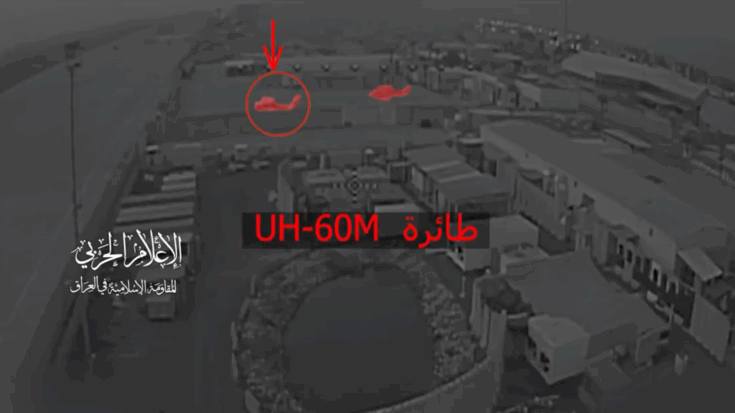
First-person view drone footage circulating online shows what appears to be a successful kamikaze drone strike on a US Army Black Hawk helicopter and a separate strike on an AN/MPQ-64 Sentinel air defense radar at the Victory Base Complex near Baghdad International Airport. The attacks, attributed to an Iran-backed militia, represent the first known successful drone strike of this type against a US military aircraft and raise serious questions about base defense capabilities against small, low-cost threats.
What the Footage Shows
The first video, filmed from an FPV drone, shows two Black Hawk helicopters sitting in a compound protected by a low blast wall. The feed cuts out just before impact near the main rotor of what appears to be an HH-60M medevac helicopter, identifiable by its configuration. Red cross identification panels on the aircraft appear to have been obscured in the edited footage. Whether the helicopter was damaged or destroyed has not been confirmed, but the drone reached the aircraft unimpeded.
An Iranian-backed militia carried out a successful FPV drone strike on Camp Victory in Iraq yesterday, successfully hitting multiple targets.
Seen here, one of the FPV attack munitions hits a parked UH-60 Black Hawk. pic.twitter.com/ngY8td9ONZ
— OSINTtechnical (@Osinttechnical) March 25, 2026
The second video is more conclusive. It shows an AN/MPQ-64 Sentinel radar in active operation, its antenna rotating, before a drone strikes it directly. Follow-up footage from a second drone confirms the radar burning after impact. The Sentinel radar is used to detect incoming threats and cue short-range air defense systems including NASAMS. Destroying the radar degrades the air defense network it supports.
Will note, appears that the Iranians are using FPV swarming tactics, with multiple drones operating together. pic.twitter.com/5094LxTOyk
— OSINTtechnical (@Osinttechnical) March 25, 2026
Unconfirmed reports suggest coordinated or swarming tactics involving multiple drones in at least the radar attack. In both videos the drone feeds show no signal degradation even at very low altitude behind structures, suggesting either very short launch distance from the targets or fiber-optic control links. A fiber-optic FPV drone would produce no radio frequency emissions for passive detection systems to identify as it approached.
Why Nothing Shot Them Down
There is no evidence in the footage or in official statements that any defensive system engaged the incoming drones. The reasons for that gap are multiple and interconnected.
FPV drones flying fast at very low level are genuinely difficult to detect. Traditional radars frequently miss them. Even microwave radars designed for counter-drone work provide inconsistent coverage at very low altitude. Surface-to-air missile systems are generally unsuitable for targets this small and slow. Gun-based systems, drone interceptors like the Coyote, and directed-energy weapons are the most relevant options, but the US military faces a chronic shortage of these systems across its deployed installations. There is no indication that directed-energy weapons were present at Victory Base Complex.






