

Vampire: Britain’s Strangest Jet
YouTube / Australian Military Aviation History
The de Havilland Vampire was one of Britain’s earliest jet fighters, designed during the final years of World War II. Although it was conceived as part of the urgent push to develop jet-powered combat aircraft, it did not see operational service during the war itself. Instead, it emerged into a rapidly changing postwar world, where piston engines were being replaced by a new generation of jet propulsion.
The aircraft was developed by the British company de Havilland and became one of the Royal Air Force’s first operational jet fighters. Its unusual layout and compact shape quickly made it stand out among more traditional aircraft of the era.
A Strange but Effective Design
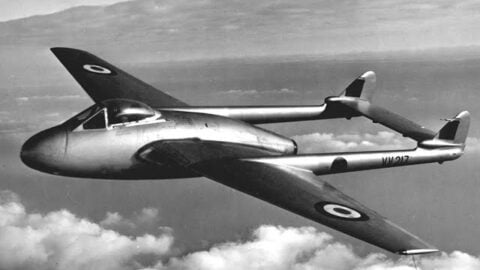
One of the most distinctive features of the Vampire was its twin-boom tail design. Instead of a single rear fuselage, the aircraft had two slender tail booms extending from the wings, connected by a horizontal stabilizer. This configuration left the central rear of the fuselage open, allowing the jet exhaust to exit cleanly.
Powered by a single Goblin turbojet engine, the Vampire had a top speed of over 500 miles per hour, making it a significant leap forward compared to piston-engine fighters of the Second World War. Despite its unusual appearance, it proved highly maneuverable and reliable, earning the respect of pilots who flew it.
The cockpit was positioned close to the nose, giving pilots excellent forward visibility. However, early versions lacked modern ejection systems, meaning flying the Vampire still carried a significant risk in emergencies.
Entering Service with Britain and Beyond
The Vampire quickly entered service with the Royal Air Force in the late 1940s, becoming one of the first operational jet fighters in Britain’s postwar fleet. It was used not only as a frontline fighter but also for training, reconnaissance, and ground attack.
Its versatility helped it become a key transitional aircraft during the early jet age. As more advanced jets were developed, the Vampire gradually shifted into secondary roles, particularly as a training aircraft for new pilots.
A Global Aircraft with Commonwealth Production
The Vampire was not limited to British service. It was widely exported and adopted by air forces worldwide. One of its most significant operators was the Royal Australian Air Force (RAAF), which used the aircraft extensively during the early Cold War period.
In Australia, production was carried out domestically by the Commonwealth Aircraft Corporation, helping strengthen local aviation industry capabilities. This allowed Australia not only to operate the Vampire but also to build and maintain it locally, an important step in developing national aerospace independence.
Legacy of an Unusual Jet
Although later replaced by faster and more advanced aircraft, the de Havilland Vampire remains an important milestone in aviation history. It was one of the first jets to prove that early jet technology could be practical, adaptable, and widely used across different roles and countries. Its strange twin boom design, once considered unusual, became one of its most recognizable features. Today, it is remembered as a bold early experiment in jet engineering that helped shape the future of military aviation.







